
Showing posts with label Asylum. Show all posts

Friday, 4 August 2017

Press Release - 40,000 ‘Lunatics’ - Scottish Genealogy Website Enables People to Discover the True Lives of their Ancestors

Logo with words purple 10cm 72dpi.jpg
FOR IMMEDIATE RELEASE

40,000 ‘Lunatics’ - Scottish Genealogy Website Enables People to Discover the True Lives of their Ancestors

4 August 2017

Glasgow, Scotland – Today Scottish genealogy website www.scottishindexes.com move another step closer to their goal of indexing all historical Scottish mental health records from 1858 to 1915. This release means the index now has 40,000 entries from across Scotland and includes people from every walk of life.
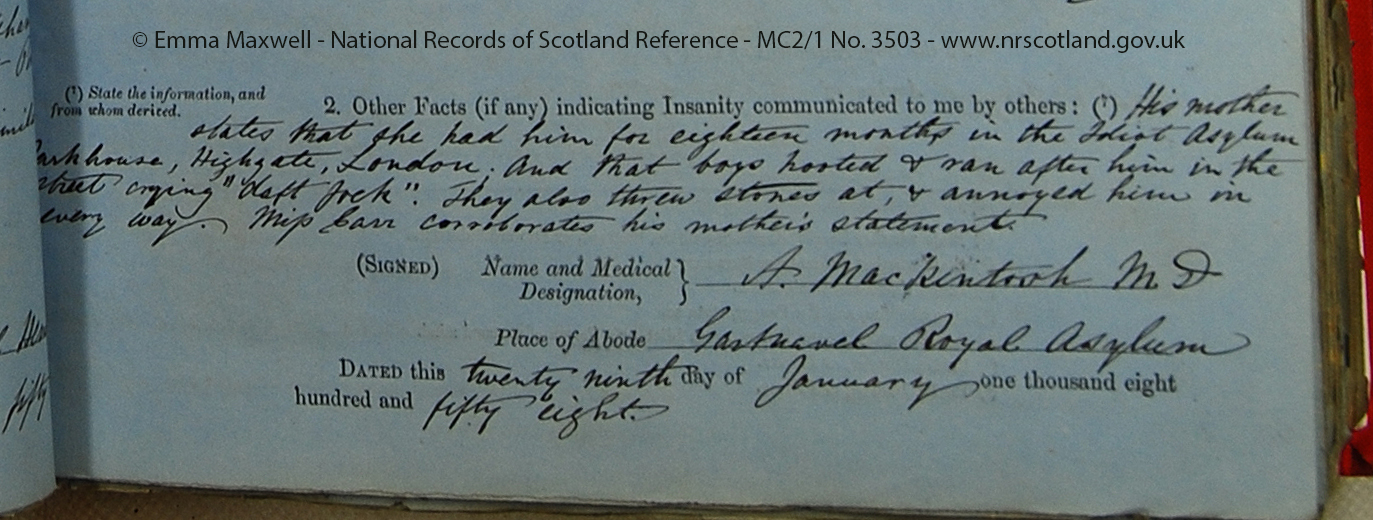

Admission forms for John Rae Thomson MC2_1 No. 3503 image 3 section _ Facts indicated by others_ the boys called him “daft feck”.jpg
John Rae Thomson - Facts Indicated by Others - “His mother states...that the boys hooted & ran after him in the street crying “daft Jock”. (More images available in the press kit)

These historic mental health records give the story behind the facts. A census record may tell you that your great-grandmother was in an asylum, but not why she was there and that’s what we really want to know. This project, lead by Scottish Indexes, is supported by a growing team of volunteers.


Emma Maxwell, genealogist at Scottish Indexes says, “Our mission is to help people not only research their Scottish family tree, but also understand the lives of their ancestors.”
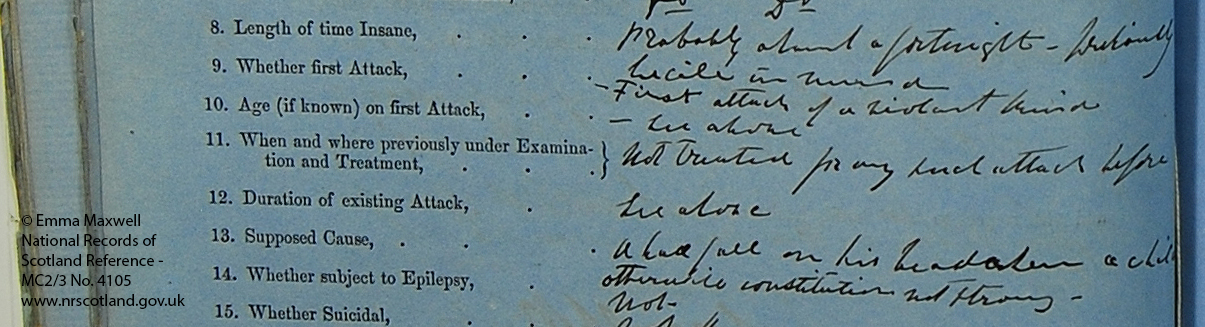
MC2_3 No. 4105 page 2 _ Question 13_ Supposed cause _  A fall on his head as a child.jpg
George Patrick Baillie - Supposed cause -  A fall on his head as a child (More images available in the press kit)


The records being indexed by Scottish Indexes are held by the National Records of Scotland (NRS) in Edinburgh. Without an index they are hugely time-consuming to search and access to the records would usually mean a trip to Edinburgh. These records contain not just names, dates and places but personal information. For example the admission form of John Rae Thomson tells us that the supposed cause of his mental health problems was ‘Premature Birth’. The same record gives his mother’s account of how boys tormented this poor 26 year-old.


Viv from Scotland says, "Although I knew that some of my relatives were in mental health institutions, the indexes at Scottish Indexes and linked original records have allowed me to find out far more about their stories. I feel that I know so much more about these people, and the information is invaluable."


Ailsa from Australia says, “I have been using Scottish Indexes for quite some time now and found many references to my own family within them. They are great for me to use from Australia.”

ENDS

For further information please contact:
Emma Maxwell, Genealogist, Scottish Indexes, info@scottishindexes.com


Notes to the Editor


  • We have prepared a press kit containing 15 images which can be used across all media platforms (download here: www.scottishindexes.com/press_kit.zip). These show full pages of the records and we have selected certain interesting sections of each page which we thought would be of particular interest to your readers. Each is embedded with a copyright statement (approved by the NRS) for your convenience. The examples given can be found in our index: MC7/1 p. 168  - John Rae Thomson and MC7/1 p. 173 - George Patrick Baillie


  • www.scottishindexes.com is run by Scottish genealogists Graham and Emma Maxwell, a husband and wife team based in East Kilbride, Glasgow, Scotland. Indexes are created by Graham and Emma with the help of a team of volunteers. All indexes are free to view and the National Records of Scotland (NRS) reference is given so users can either access the documents without charge at the NRS, or purchase the service from Scottish Indexes.


Monday, 23 May 2016

Life in the Asylum

There is no denying that asylums across Scotland varied greatly in the mid-nineteenth century. Some details that were published in the 1857 Royal Commission Report are quite sobering. Some accounts however are quite encouraging. I like the entry for Miss Campbell's House:

"MISS CAMPBELL'S HOUSE, MUSSELBURGH; Visited 2d May 1855.

A good house, in a garden. There is only one patient, an old lady, who has been here many years. She was out walking, accompanied by an attendant, when the visit was made. On a second visit she was seen, and appeared to be comfortable, and properly taken care of."

By searching our index for all entries for “Miss Campbell's House” we see that Miss F. Gordon entered the asylum on 9 December 1812, it’s nice to know that she was so well cared for. The full entry in the General Register tells us that Miss F. Gordon died in August 1869.

There are many surviving records for our ancestors who were admitted to Scottish asylums. The national series of records show the date of admission, some background information and when the person died or otherwise left the asylum. The records of individual institutions, now often deposited in local archives, can give details on treatment and sometimes even contain photographs.

From the new section of our website you can read about each Scottish mental health institution, locate it on a map and in most cases find out where the records are now held. We update our database regularly so keep checking back to see what new records we have indexed.

Monday, 14 March 2016

SAFHS Conference and Family History Fair 2016

We are looking forward to the 27th “Scottish Association of Family History Societies (SAFHS) Conference and Family History Fair” which will take place this year in the wonderful conservation village of New Lanark on Saturday 23 April 2016.

The SAFHS conference is always a highlight in the genealogy calendar. There is a long list of exhibitors and an interesting selection of talks. The theme for the day is "Heritage along the Clyde" so the event will be of particular interest to you if you had ancestors who lived and worked along the banks of the Clyde river.

Emma Maxwell, genealogist
at Scottish Indexes, will be speaking on the
subject ‘Understanding Our Ancestors -
 A Look at Prison Registers and Mental Health Records’
For those of you with ancestors from other areas of Scotland, many of the family history societies will be present and there will also be representatives from commercial companies such as Findmypast and Scottish Monumental Inscriptions, as well as us of course!

There will be four talks given throughout the day, the cost of which is very reasonable: 4 talks £16 or 4 talks and buffet lunch £20.

Speaker 1 is Jane Masters who will give the talk, ‘New Lanark Mill’
Speaker 2 is Dr Irene O'Brien who will give the talk, ‘Industries along the Clyde - Records held in the Mitchell Library’
Speaker 3 is Dr Stephen Mullen who will give the talk, ‘Glasgow, the West of Scotland and New World Slavery, 1660-1838'’
Speaker 4 is Emma Maxwell who will give the talk, ‘Understanding Our Ancestors - A Look at Prison Registers and Mental Health Records’

If you are interested in hearing one or more of the talks it is advisable to book now to ensure you get to hear it. You can book online from the conference website: http://safhs2016.weebly.com/store/c1/Featured_Products.html

We look forward to meeting many of you on the 16th of April, please come along and say hello.

Tuesday, 5 August 2014

An Index to Historic Scottish Mental Health Records Goes Online

The Mental Health Foundation say that “1 in 4 people will experience some kind of mental health problem in the course of a year”. As a society of people we have become better at understanding mental health problems, although there is still a lot of room for improvement. The sad reality is that our ancestors didn’t have the understanding, support or treatment that we have today.


Have you had an ancestor ‘disappear’? Have you scoured the census and passenger lists just to draw a blank? Have you come across an ancestor listed in the census as an imbecile or idiot? Did you feel hurt for the poor soul and want to understand more?


With the help of a team of dedicated volunteers we are indexing the "Notices of Admissions by the Superintendent of Mental Institutions".


Today we have uploaded an index to the first 619 records (from 1858 and 1859) and we will be adding more on almost a weekly basis. Follow me on twitter or Facebook to keep up-to-date.


The original records can not only be genealogically useful but they can also help you peel back the layers of history and uncover your family story. Why did your great-great grandmother leave her children? Why did nobody ever talk about your great-great-uncle?


The original documents, which we can help you research, contain two doctor’s accounts of what they observed the patient to be like and what relatives had reported. These reports may say, for example, that the patient became withdrawn after the death of a husband or the birth of a child. Some report the symptoms started after financial losses or disappointment in love.


Tuesday, 21 January 2014

Understanding Our "Lunatic" Ancestors

Lunatic, Imbecile or Feebleminded

It can be quite a shock for many people when they first see the column on census pages headed: “If any person in this Schedule is:- … Lunatic, Imbecile or Feebleminded”. Variations on this question were asked from 1871, when the question was “Whether: 1. Deaf-and-Dumb 2. Blind 3. Imbecile or Idiot 4. Lunatic.” What can come as a greater shock than the phrasing of the question is when we discover that our ancestor is listed as an “Imbecile” or a “Lunatic”!

Greater Understanding

As time has passed a greater understanding of mental health has led to kinder and more specific terminology as well as huge improvements in the help available for sufferers. When we see such a reference we may immediately want to know more about the condition our ancestors had.

The Archives

In Scotland there is a fabulous resource held by the National Records of Scotland (NRS). Whilst these politically incorrect terms are used in the records there is also a description of the facts as seen by the doctor at the time, and as related to the doctor by other individuals. This means we can move beyond the words “lunatic” or “idiot” and understand more about the people behind the terms and how they were suffering”.

The documents are recorded under the reference ‘MC’ in the NRS. The most informative series is MC2 which is entitled “Notices of Admissions by the Superintendent of the Mental Institutions”. These notices of admissions start in 1858. There is also a register, containing less detail. The register begins in 1858 but includes all those already within the system at that point in time. So if somebody entered an asylum in 1820 and was still there in 1858 they are in the register but a person committed in 1850 but who left in 1856 will not be in the register. The references for these registers begin MC7 (see the NRS catalogue for years and full references).

Example

Let’s say then we have been doing some research and we have come across Marjory Methven in the 1861 census, who is listed as a patient in the Royal Lunatic Asylum. We may want to learn more about poor Marjory.

I have found her in the “Notices of Admissions by the Superintendent of the Mental Institutions”. The record begins:

“I herby give you notice, That Marjory Spence or Burrell or Methven, a pauper lunatic of the Parish of Edinburgh was received into the Eastern Division of the  Poorhouse Edinburgh as an Insane person on the Twenty-third day of February and I herewith transmit a Copy of the Order and Medical Certificates and Statement on which she was received…” [this notice was signed by a doctor in March 1858].

On the next page is a form to be filled out, asking again for name, age, marital status etc. It also asks:
8 - Length of Time Insane
9 - Whether first attack
10 - Age (if known) on first Attack
14 - Whether subject to Epilepsy
15 - Whether Suicidal
16 - Whether Dangerous to others
17 - Parish or Union to which the Lunatic is Chargeable
18 - Christian Name and Surname, and Place of Abode, of nearest known Relative of the Patient, and degree of Relationship (if known), and whether any Member of his Family known to be or have been Insane

In our case questions 8-13 are answered as “Not Known”, and questions 14-16 are answered as “No”. Number 18 gives the detail: “Miller Methven, her husband, 203 Cannongate. Not known whether any of the family are or have been insane.” [this page is again signed, this time by the Inspector of the Poor].

Next we have a notice from the Sheriff-Clerks Office saying that Marjory Spence or Methven can be admitted.

The Facts of the Case

On the following page we have the medical certificate, which is where we begin to find out some real detail about poor Marjory.

“I, the undersigned John Smith M.D., being a Physician and being in actual practice as a Physician do hereby certify, on soul and conscience, that I have this day at the Eastern Division of the Edinburgh Poor House in the County of Mid-Lothian separately from any other Medical Practitioner, visited and personally examined Marjory Spence or Birrell or Methven, and that the said Marjory Spence or Birrell or Methven is a Lunatic and a proper Person to be detained in a Poorhouse under care and treatment, and that I have formed this opinion upon the following grounds, viz: -

  1. Facts observed by myself: She says she has just come over from Kirkcaldy to be crowned Queen, that she received papers telling her to do so, that the papers were given by Soldiers, but she does not know who sent the papers. - Was taken up by the Police, having a crowd about her calling out Victoria.

(Signed) John Smith M.D. Physician, 20 Charlotte Square.

We have a second physician, completing the same form:

. . . I have formed this opinion upon the following grounds viz: -

  1. Her fantastic dress & incoherent language. She labours under delusions, for example that she is Queen of England, and that she is about to be married to a Nobleman.

(Signed) William D. Adams M.D., 5 Argyle Square


And there you have it, that’s the sort of thing you can find in the MC records held by the National Records of Scotland. These records can certainly help us to have an insight into our ancestors.

Indexing

If you need help to access these records please get in touch. Records under 100 years old are not available to the public but earlier records can be consulted. There was an index created but at the time the closure on the records was only 75 years. This means that the index itself is now closed as some of the material indexed is from less than 100 years ago. The best finding aid at the present time is therefore the register of lunatics, NRS reference  MC7. This gives date(s) of admission and a number. This number stays with the same individual throughout their admissions.

What we really need is an index, as in the case of so many valuable records at the NRS. If you would like to volunteer to help please get in touch with me.