Showing posts with label reserch. Show all posts

Thursday, 30 April 2015

The people behind the names


The Kelso Dispensary 
When you trace your genealogy you research the names, the dates and the places. This has to be step one. The second step, though, is digging a little deeper and finding out extra details that can help you understand somebody’s life.

Take this entry in the 1851 census of Stichill, Roxburghshire: Margaret Guthrie, aged 73, born in Greenlaw, married to James Guthrie. James and Margaret have a daughter living with them, her name is Alison and she is 30 years old. You can see the full entry on our website.

Tracing James and Margaret back to the 1841 census we see they that are living in the same house. A quick search online tells us that James Guthrie married Margaret Waddel in 1807, in Stichill.

Using these common genealogy tools we have learn something of James and Margaret. What else can we learn? Thanks to a generous contribution through our ‘Sponsor an Index’ scheme we can learn something remarkable.

When just 16 (in 1780) years of age Margaret was seen at the Kelso Dispensary due to ‘Obstructed Menses’. How scared she likely was as a young girl being seen by a physician in an age when this was very rare. We do not know how severe her condition was but it is possible that it is only because of the kind (and free) help of the Kelso dispensary that Alison was ever born.

The lesson for us, don’t be content with a list of names, dates and places; dig deeper, search more records and learn more about the lives of your ancestors.

Monday, 8 September 2014

Using www.scottishindexes.com to the full

As well as searching www.scottishindexes.com by name you can also search by keyword alone. This means it’s good for one place studies, but also for searching for different types of people. Let’s take an example: bondagers and hinds.


There was a practice amongst agricultural communities, mainly in the south-east of Scotland and north east of England where a man employed on a farm as hind would supply a young woman to work on the fields; she was known as a bondager.


When a man was newly married, his wife might work as a bondager. Once they had children and the married woman could no longer work in the fields, another relative, perhaps her sister would fulfil this role, until eventually a daughter was old enough to provide the labour. If there was no female relative to take the job, it was common for a woman from outside the family to become the bondager.


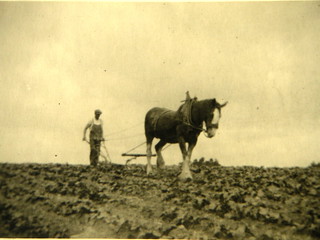
The hind would generally be a ploughman, having the important responsibility of looking after the horses, an integral part of any farm. The bondager would work in the fields, particularly during the harvest season.

Ploughing


The hind would often be ‘paid in kind’, often grain and a little land to cultivate. Any surplus could be sold at the market. The bondager could be paid in cash, or her wages might be the house in which they would all live.


You  can see an example of this situation in our 1841 census record.


As the 19th century progressed, the custom gradually began to die out. If we follow the same family we saw in the 1841 census to 1851 we see John now described as an ‘Ag. Lab’. Another young woman is with the family, this time being described as a Farm Servant.


Exactly what arrangement was made is difficult to know, it could be a that Margaret was a bondager but not recorded that way in the census. We know however that the practice was dying out so perhaps the arrangements had changed.


To learn more about hinds and bondagers I would recommend www.thebondagers.com and www.foodheritage-berwick.org.uk.