Showing posts with label National Archives of Scotland. Show all posts

Monday, 12 February 2018

Scotland's First World War Pensions Appeal Records

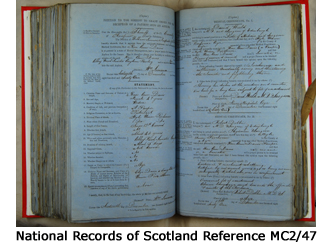
Work has begun on indexing Scotland's First World War Pensions Appeal records. Until now these records have been arranged by month of hearing. This means that unless you knew when the appeal happened you might have to search 288 boxes to find the paperwork for your ancestor! Not very practical. 

These records hold vital information for around 30,000 Scottish servicemen and the reports can help you understand what these men went through. Here is an example for you.

Name: George Blane

Unit, Rank and No.: 9th Btn. Seaforth Highlanders, Private, No. 4437

Date of Hearing: 5 January 1920

Age: 26

Last Address: 14 Mossvale Street, Paisley

Report and other documents from Paisley L.W.P.C.

Man’s Statement:

I enlisted on 10th September 1914 at Paisley Barracks and went to Fort George where I commenced my training. This training lasted till 23rd November, 1914 when I was finally discharged as no longer fit for service on account of having Chronic Bronchitis. This disability was brought on by constant exposure in very severe weather. I was wet through about twice a week, sometimes with the water running out of my boots and was only provided with one shirt and pair of drawers at the time and could not therefore change my underwear. Very often I had to stand in my trousers and dry my shirt before the fire. I hold that it was due to this condition of things that I contracted my disability. I never had bronchitis before I enlisted and was constantly on the road conducting my business as a general dealer, and through this Chronic Bronchitis I am no longer able to stand the exposure which is required of me.

Historical Search Room - National Records of Scotland
The above (reference PT6/2 held by the NRS) is just part of the record but it gives you a sneak peek at what will be coming. Find out more by reading the NRS blog.

If you want to find out more about the lives of your ancestors our genealogists can help. We can research in Scottish archives and help add colour to your family tree.

www.scottishindexes.com

Friday, 4 August 2017

40,000 Scottish Mental Health Records

We have been working along with a very hard working team of volunteers and we have now reached a milestone in our project to index Scottish mental health records. We have indexed the first 40,000 entries.

If you have not used these records before you will be amazed by them. Sometimes the stories are sad, sometimes reassuring, but there are so many stories to tell. For example here is an excerpt from the entry of Jean McTavish or McAlpine. Jean was aged 60 and a widow, it seems that the ‘supposed cause’ of her health problem was intemperance. Below is an account of what a doctor observed. It seems she imagined herself to be only 26 years of age, and that she was a bird.

Reading these records makes the people come to life in our minds, I can almost picture poor Jean in front of the official, looking rather older than her 60 years perhaps, but all the while believing she was only 26. Granted, this record does not answer all our questions, but it makes Jean real. It tells us more than the basic records and it preserves the memory of poor Jean for her descendants.


Monday, 5 December 2016

Scottish Kirk Sessions

The biggest problem I have in my work is that I am way too easily distracted! Here is an example. I was searching the Tongland Kirk Session Minutes (CH2/1244/2) in the National Records of Scotland the other day and found this very interesting entry from 2 September 1869:

Voluntarily compeared Ann Bird or Morton wife of Joseph Bird, Sailor who confessed that in the month of October last she gave birth to a child in uncleanness, she having been married in the month of July previous: On being admonished to be ingenuous and to speak the truth, she declared that Jonathan Turner was the partner of her guilt and the father of her child. Her husband Joseph Bird is known to bear testimony corroborative of the statement, and although disowning the paternity of the child has adopted it as his own. Having been solemnly admonished by the Moderator she was absolved from scandal.

Tongland Kirk
A search in the birth records found the birth certificate of the unnamed child. James Morton (or Bird) was born on 1 October 1865, and it is column 4 of his birth certificate which is the most interesting. Column 4 on a Scottish birth certificate gives the ‘Name, Surname, & Rank or Profession of Father, Name, and Maiden Surname of Mother And Date and Place of Marriage’. In this column on James’ birth certificate we read: “Ann Morton, married on 22nd July last to Joseph Baird, sailor who she declares is not the father of the child, & further that he was at sea for Months prior to 18 July 1868.”

A search in the census of 1871 shows that James (aged 2) was living with his maternal grandparents. I’ve not traced this family any further as I really should be doing research for clients but if you are related I would love to hear from you.

What do we learn from this? It is important to look at as many records as possible to get a full picture of what’s going on within a family, which can take effort. Historic Scottish birth certificates are available online but Kirk Session records are not (yet). For the time being you can access them in Edinburgh and various satellite locations around Scotland, including archives in Hawick, Aberdeen, Kilmarnock and Glasgow. There are other archives who also have access to the digital images, it’s worth checking with the National Records of Scotland to see if an archive near you has access.

The fact that the Church of Scotland Kirk Sessions are digitised is a great help but there is as yet no index to most of these minutes. Having said that, I wouldn’t have found this entry if I had used an index, when you browse a volume interesting entries jump out at you. If your family is from a small to medium-sized parish in terms of population, and you have access to the digital images, I would recommend browsing the volumes; who knows what you will discover!


Monday, 23 May 2016

Life in the Asylum

There is no denying that asylums across Scotland varied greatly in the mid-nineteenth century. Some details that were published in the 1857 Royal Commission Report are quite sobering. Some accounts however are quite encouraging. I like the entry for Miss Campbell's House:

"MISS CAMPBELL'S HOUSE, MUSSELBURGH; Visited 2d May 1855.

A good house, in a garden. There is only one patient, an old lady, who has been here many years. She was out walking, accompanied by an attendant, when the visit was made. On a second visit she was seen, and appeared to be comfortable, and properly taken care of."

By searching our index for all entries for “Miss Campbell's House” we see that Miss F. Gordon entered the asylum on 9 December 1812, it’s nice to know that she was so well cared for. The full entry in the General Register tells us that Miss F. Gordon died in August 1869.

There are many surviving records for our ancestors who were admitted to Scottish asylums. The national series of records show the date of admission, some background information and when the person died or otherwise left the asylum. The records of individual institutions, now often deposited in local archives, can give details on treatment and sometimes even contain photographs.

From the new section of our website you can read about each Scottish mental health institution, locate it on a map and in most cases find out where the records are now held. We update our database regularly so keep checking back to see what new records we have indexed.

Monday, 26 October 2015

Smallpox in the National Records of Scotland

Smallpox is a word that has inspired fear for generations. Our ancestors suffered with little help and it was not until the 26th of October 1977 that the world’s last naturally occurring case was discovered.


We are the product of generations of ancestors who survived long enough to have children, but we know that sadly many of our ancestors’ siblings did not survive. It is rare to find detailed health records of our ancestors, so although we might theorise that they endured diseases such as smallpox we do not often have any evidence one way or the other.


Clues do exist, though, if you know where to look. One interesting source is the prison registers held by the National Records of Scotland. Victorian prison records are very detailed, and one of the columns on the registers was headed ‘Marks’. In this column, as well as finding details of tattoos or scars, we commonly see written ‘pock marked’, ‘poxpitted’, ‘pock pitted’ and even ‘Marked with small pox’. A person could become pockmarked by various skin conditions, but smallpox was a major cause of such scarring. Depending on the description used, it can be very clear that they suffered from smallpox at some point in their life, information which may not be found in any other record. The image to the left shows William Phillips and Betsy Phillips are recorded as being marked with the smallpox in an 1848 prison register; you can search an index to these records on our website.


Another source of information is the Kelso Dispensary patient records, which are also held by the National Records of Scotland. These records provide a fascinating glimpse into the history of smallpox. Founded in 1777, this charitable institution saw patients with many ailments, and smallpox is frequently seen in the records. Between October 1793 and October 1794 the Dispensary saw 29 cases of smallpox, with one case resulting in death.

Click to see image full size

The records of the Kelso Dispensary document many cases of smallpox. Above we see an entry for Thomas Tenant who died of the disease in 1797. This entry is again from the National Records of Scotland, their reference number for the document is HH71/43.

In 1796 a physician named Edward Jenner discovered that infecting someone with cowpox gave them protection from the much more dangerous smallpox. This was effective because when a person was exposed to cowpox, the human body produced antibodies which helped protect them from smallpox. This was the world’s first vaccine!

The vaccine came too late for poor Thomas, though. Just a few years later, on 10 August 1800, we see the first entry of smallpox inoculation by the Kelso Dispensary. Sadly the names of the children are not listed but these ten children surely have a place in history.

Click to see image full size

As with many new ideas the smallpox inoculation (or vaccination) was not universally accepted. Cartoons of the time depict the fear that the public had at the time, that somehow the cowpox may turn them into a cow! Science prevailed however and the results were clear. In time an improved vaccine was made and the rest, as they say, is history. This terrifying disease now only exists in laboratories, let’s hope it stays that way!

When researching our ancestor’s past we are not content with a lists of names, dates and places, we want to dig deeper and understand the people we are descended from. By looking at a variety of records you can do that too. We are working on a project to index Scottish prison and health records so that you can trace your family tree and find out more about the people behind the names, including the diseases they had to endure. Search www.scottishindexes.com for the names of your ancestors and discover more about their lives.

A page from a prison register

Wednesday, 6 May 2015

Using Marriage Contracts to Trace Your Family Tree

Marriage contracts are just one type of deed that can be very useful when you are tracing your family tree. As well as detailing the persons getting married they frequently mention other family members including parents, siblings and sometimes even more distant family members. They were usually drawn up by families who had land or wealth of some kind. If your family worked on the land rather than owned the land you are unlikely to find a marriage contract. 

There was no legal obligation to register a marriage contract, it was a private document. As a fee would be involved in registering the document it was often only done if and when it became necessary. For example, a marriage contract could be dated 12 July 1735 but only registered on 20 December 1769; as you can see in this entry on our website index. 

Finding these marriage contracts without an index can be challenging and time-consuming. That is why we have decided to begin indexing sections of the Register of Deeds that are currently un-indexed. We hope this project will uncover many genealogical gems that will help you and others research your family tree.

So far we have indexed 1,072 entries… there’s a long way to go! We are indexing these under the ‘Sponsor an Index’ initiative: can you help? From just £7 you can be involved in getting Scotland’s historic records online: http://scottishindexes.com/sponsor.aspx

Thursday, 30 April 2015

The people behind the names


The Kelso Dispensary 
When you trace your genealogy you research the names, the dates and the places. This has to be step one. The second step, though, is digging a little deeper and finding out extra details that can help you understand somebody’s life.

Take this entry in the 1851 census of Stichill, Roxburghshire: Margaret Guthrie, aged 73, born in Greenlaw, married to James Guthrie. James and Margaret have a daughter living with them, her name is Alison and she is 30 years old. You can see the full entry on our website.

Tracing James and Margaret back to the 1841 census we see they that are living in the same house. A quick search online tells us that James Guthrie married Margaret Waddel in 1807, in Stichill.

Using these common genealogy tools we have learn something of James and Margaret. What else can we learn? Thanks to a generous contribution through our ‘Sponsor an Index’ scheme we can learn something remarkable.

When just 16 (in 1780) years of age Margaret was seen at the Kelso Dispensary due to ‘Obstructed Menses’. How scared she likely was as a young girl being seen by a physician in an age when this was very rare. We do not know how severe her condition was but it is possible that it is only because of the kind (and free) help of the Kelso dispensary that Alison was ever born.

The lesson for us, don’t be content with a list of names, dates and places; dig deeper, search more records and learn more about the lives of your ancestors.

Sunday, 19 April 2015

Sponsor an Index


The Problem!

Just a few short years ago there was very little in the way of online genealogy indexes. Tracing your ancestry was slow and time-consuming. Today the world has changed, and many people can trace their family tree in Scotland using online records, perhaps getting back as far as 1800 in just a few hours!

Sometimes, though, we hit a roadblock. We may also be intrigued about the lives of our ancestors and want to dig deeper.

Even if we know that records exist that could help us further, if there is no index and we are not fortunate enough to live near the archive where these records are held, it can be very expensive to have someone research our family tree for us. What we need is an online index!

Large companies are working on this situation by indexing a large number of records, then selling subscriptions. This can be useful if the company has a large number of records that you want, but can be frustrating if you sign up to find out they don’t have the records that will help you.

We want to provide a free website, one which gives you the source reference of the original document so that you can go and view the original record for free, or if you can’t visit in person pay just a small fee for the record you need.


The Solution

We are finding that more and more clients ask us to search records that could also be useful to other researchers. This has left us with the conclusion that it may make more sense for individuals to ‘sponsor’ an index. This way the genealogy community as a whole only pays once for the indexing to be done. The index goes online for free and then all your distant cousins can use it too.


How it works

You sponsor an indexer to spend a set amount of time (in 30 minute blocks) to index a record of your choice, with a date range of your choice. That set amount of time will be spent on indexing the record you have chosen, and then the index will be made freely available online for everybody to access. As a sponsor your name will accompany the release of the new index entries, and  will also remain permanently on our ‘Sponsor Appreciation Page’. Additionally, if the new index contains a specific entry you are looking for you will receive it free of charge.

We have a list of records ready and waiting to be indexed, but if you don’t see what you need get in touch and we’ll see if we can index the record you’re looking for.

30 minutes - £7
1 hour - £10
5 hours - £40

Most items held by the National Records of Scotland can be indexed, but there may be additional charges, get in touch and we’ll see what we can do. Search their catalogue to see what treasures they hold that we could help you access.


How much will be indexed?


How much can be indexed in a set period of time depends on the type of records involved. The ‘Notices of Admissions by the Superintendent of the Mental Institutions’ are one of the slowest records to index. A volume (one month) can take up to ten hours! Prison registers are among the quickest, with over 100 prisoner entries being possible in an hour. Once we know the record you are interested in, we can advise as to the amount we can likely index in the time available.


What to do next

Visit our ‘Sponsor an Index’ page on our website and choose how long you would like us to spend indexing the record of your choice. Add that time to the PayPal cart and proceed to the checkout. Once your payment is through I will email you and you can tell us what you would like us to index. You can find the list to pick from here.


Wednesday, 15 April 2015

A good dig through dusty documents!


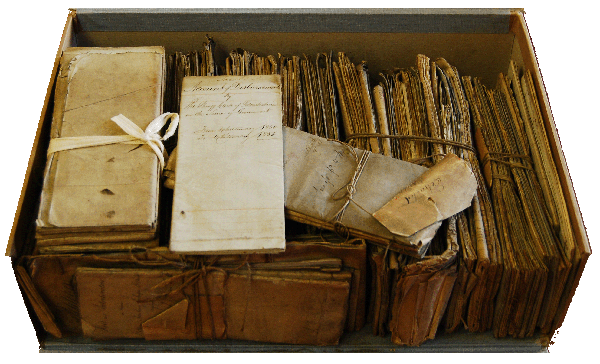
One of the things I love about being a genealogist is that every day is different, you can never know exactly what you’ll find. I was looking through some Dumfries Sheriff Court processes the other day (on the hunt for ‘paternity’ cases) and came across a case innocuously entitled Jones v Lochmaben. As this bundle of folded papers tied up with string was larger than the others and appeared to contain some sort of notebook I untied the string to have a nose inside. 

This lengthy case was regarding the ‘Nuisances Removal (Scotland) Act 1856’. It would seem that far from being the picturesque holiday destination that it is today, back in 1866 Lochmaben had a big problem with dung, pigsties and general filth.

Amongst the items was a large document entitled: “Report of list of Nuisances in the Burgh of Lochmaben on 6th and 7th November 1866”.

Within are contained the names and addresses of 182 households, detailing the condition of the property. I found this item fascinating, it tells us so much about the town that after reading a few entries you could almost smell the place!

Here are some excerpts: 

No. - 140

Date of Inspection - 7th [November 1866]

Name and Occupation of Occupants of Premises - Ebenezer Brown Hill, Free Church Manse 

Description of Nuisance - An accumulation of dung and filthy stagnant water and very dirty yard.

Remarks - [In pencil] None*

No. - 141

Date of Inspection - 7th [November 1866]

Name and Occupation of Occupants of Premises - John Clark, Schoolmaster 

Description of Nuisance - A necessary* containing in and about it a great accumulation of filthy matter.

Remarks - [In pencil] None

No. - 167

Date of Inspection - 7th [November 1866]

Name and Occupation of Occupants of Premises - Robert Thorburn, Labourer.

Description of Nuisance - One Pigsty containing one Swine and an accumulation of Dung at Back of House.

Remarks - [In pencil] Nuisance

No. - 176

Date of Inspection - 7th [November 1866]

Name and Occupation of Occupants of Premises - John Green, Carter

Description of Nuisance - A House unfit for Human Habitation Occupied by Green. Having only one small apartment and his Family consists of Himself, Wife and 7 children. The House is Thatched on roof and they Occupy one Small apartment in which there is 3 Beds and where they all live both night and day. No ventilation. Bad House. 

Remarks - [In pencil] Nuisance.

No. - 178

Date of Inspection - 7th [November 1866]

Name and Occupation of Occupants of Premises -Barnard Kelly, Hugh McGauchie, William Helon

Description of Nuisance - All keep Lodginghouses with no Rules and Regulations formed for their Guidance and Conduct. 

Remarks - [Blank]


The dusty documents make your hands quite dirty!
I hope I am not alone in being fascinated by this document and as we continue our research in the Sheriff Court records of Scotland I hope to come across more wonderful accounts like these. 

This particular record does not neatly fit into our existing collections, so for the time being we have created a PDF index to this specific record which you can download for free from our website; just click this link.

If you are researching your Lochmaben forebears and see an entry relating to your family please get in touch and I will email you the full account relating to them.

*We presume the ‘necessary’ was the toilet… it’s mentioned as a ‘necessary’ quite frequently.
*The remarks in pencil we believe to have been added at a later date, perhaps on a subsequent inspection.

Wednesday, 24 September 2014

No Books Were Harmed in the Making of this Index

Day after day people visit archives around the world and look at historic paper records. Sadly each time these items are handled they deteriorate. There is no point, though, in keeping records if nobody can ever access them!


Letter found in Sheriff Court records.
NRS reference number SC62/10/390 Heatlie V Bell 
Back in 1911, when access was requested to the Old Parish Registers of Scotland (OPRs), the then Registrar-General (James Patten McDougall) said “...I am afraid it would open a very wide door and might lead to abuses, e.g. the public would come here without having recourse to the ordinary registers, and their object in coming might be prompted by mere inquisitiveness. Further I am afraid that these old books would not last long if handled by all and sundry.”


I wonder what poor James would make of Scotland’s People? Perhaps he would be delighted as it means that we do not have to handle the original volumes any more. While we might find his words amusing, we also must acknowledge the point: the more often books are handled the more quickly they will wear out!


Whilst the OPRs, census returns, valuation rolls, birth, marriage and death records have now been digitised this is a drop in the ocean of what exists in the National Records of Scotland.


Mental Health Records.
NRS reference number MC7/1

The documents Graham and I are indexing for scottishindexes.com have not been digitised, meaning that we are making use of the original records. As such, we have a responsibility to look after the records we access and avoid damaging them for future generations.


On occasion, we find that cannot read a record in entirety, often because a volume has been bound tightly and some of what is written is obscured by the binding.


When this happens, it may mean that a record, or index entry cannot be completed. In such cases, we insert in square brackets what we believe will complete the record, or indicate that something is missing.

When searching scottishindexes.com and you see square brackets you’ll now know what they mean, and you can rest assured that no books were harmed in the making of the index!

Thursday, 10 July 2014

Into the archives - McVitie's

One of the exciting things about a trip to the National Records of Scotland is that you never quite know what you’ll discover. The other day we were delving into court records from the mid-1800s, many of which exist as small brittle bundles of notes and relevant documents tied up with string. One such bundle, pertaining to a case of land ownership, yielded a few pages from an old newspaper – the relevant information outlined in pen.


General Register House © Ceris Aston

Our eyes were drawn, however, to the advertisements – one Mrs Carstairs, Fruiterer and Florist, announcing her upcoming move to ‘those Central and Commodious Premises in the ROYAL EMPORIUM’. Another: James Carstairs, Poulterer & Game Dealer, respectfully intimating that his new premises open ‘THIS DAY… with a complete Stock of the very best POULTRY, GAME, &c.’

We delighted in the formality and archaic language of the adverts – even in the capitalisation of the nouns. These 19th-century shopkeepers were savvy though, with Mrs Carstairs being quick to address the announcement to ‘her numerous Customers’, and James Carmichael invoking loyalty and respect for tradition as the ‘Grandson and Successor to the late Mrs Janet Young’. Modern advertising still uses some of the same techniques – just not in quite such a polite manner!


Delving into the records © Maxwell Ancestry
Then we glimpsed a familiar name.


ROBERT MCVITIE, BAKER, 5, CHARLOTTE PLACE,
begs gratefully to acknowledge the very flattering amount of patronage which he has received since he entered the above Premises; and at the same time respectfully intimates, that having had his accommodation increased, he has commenced the CONFECTIONARY in connection with his LOAF-BREAD BUSINESS, and assures his Friends and Patrons that they may rely on everything produced being of the very best quality. (North British Advertiser, Jan. 1st, 1853).

We looked it up – how could we not? And it was he. One Mr Robert McVitie, born 1809, taking his first steps towards a future which would give the world the McVitie’s digestive biscuit. The baking dynasty which he founded still flourishes today and digestives are arguably the nation’s favourite biscuit. As we sit with a cuppa and a nice dunkable digestive, we reflect that McVitie’s 1853 decision to expand into confectionary was, all things considered, a good move.


It’s fascinating to find records of such moments, especially when we are familiar with the stories or legacies from long ago events. We’re looking forward to our next find – see you next #throwbackthursday!

Tuesday, 13 May 2014

Love in the Archives

Regular readers of my blog may remember that I wrote about the ‘Notices of Admissions by the Superintendent of the Mental Institutions’ a while ago. They are very interesting documents held by the National Records of Scotland under the reference MC2.


These records can help with genealogy and add to your personal family story. More than that though, they are of national importance as they document a period when doctors and others were trying to get to grips with mental health problems. Each record includes the reports of two doctors, both on what they have observed and on what has been reported.


Yesterday I came across a record that described a poor young chap this way:


‘Falling in Love with many Ladies at the same time...’


It seems from these records that the poor lad also thought he was going to be poisoned and seems to have turned to drink. I’ll try and find out what happened to him, I hope it all turned out well!


It just shows the value of searching records beyond the obvious Birth, Marriage, Death and Census records. To properly research your family tree you need to get to know what is available both in the National Records of Scotland and local archives.


Sign up for my newsletter to receive tips on how to do this in Scotland: http://www.maxwellancestry.com/ancestry/newsletter.htm

Wednesday, 30 April 2014

Major Glitch in the National Records of Scotland Online Catalogue!

Update 6 May 2014: I am pleased to say the NRS catalogue has now been fixed!


Major Glitch
There is a major glitch in the catalogue of the National Records of Scotland (NRS). I'm not sure when it started but we discovered it on Sunday and reported it on Monday (28 April 2014). It has been reported by the staff to the relevant department so let's hope it gets fixed quickly.


What Happens
We discovered the glitch by searching for the Kelton Kirk Session records. In the top box we put 'Kelton' and in the second we put 'CH' as below:

No results where found. This surprised me. I searched online and found the top level reference for the Kelton kirk session records. Went back to the catalogue with that reference:


Records of Kelton Kirk Session 1715-1903! This should have come up in my initial search.
We had a bit of a rummage and discovered that this is happening a lot, we know that the items not showing up number into the thousands at the least. If you use only the document reference you can find items, but not by searching for words in the titles of items: which is how must of use will use the catalogue!


In the Building
The catalogue works in the building using the NRS intranet, I believe it's just the online version that's not operating correctly. NRS staff are aware of the problem. Meantime, while the NRS work hard to get this fixed, feel free to email me as I'm in the National Records of Scotland a couple of times a week and can do a search for you. I would not recommend using the online catalogue until this glitch is fixed!