Showing posts with label family history. Show all posts

Thursday, 26 May 2022

Genealogy mistakes to avoid #4 - Ignoring the occupation

When trying to match our family up with the records it can be a real challenge when they have common names and lots of cousins in the same parish also have the same names. It can be a real tangle. 

Sometimes we’re so focused on the names we forget about the occupation. Although people did sometimes change their occupation, it’s fairly unlikely that a married man would change occupation from a stone mason to a shoemaker. Both of these occupations would require an apprenticeship. Our ancestors would have served as an apprentice as a teenager and perhaps into their early 20s before they got married. How would a married man with children afford to be able to serve an apprenticeship and switch professions as we can today? 


Of course, some occupations are the same but described differently. A shoemaker in one record may be described as a cordiner in another. A shipwright may also be described as a joiner. Or you may find a grocer being described as a victualler. If you come across an occupation that is uncommon today, check out the Dictionaries of the Scots Language to discover what it was.


Tuesday, 3 May 2022

Did your ancestors work the land?

If your ancestor was a farmer, shepherd or agricultural labourer you may be able to find information in estate records. 


Families who owned large estates would need their own records. These might record who were their employees, or who rented their farms. These records can be useful when you are researching your family history. For example, it’s not unusual for a farm to be rented by generations of the same family. This can be crucial information for periods when there are no census records or there are gaps in church records.

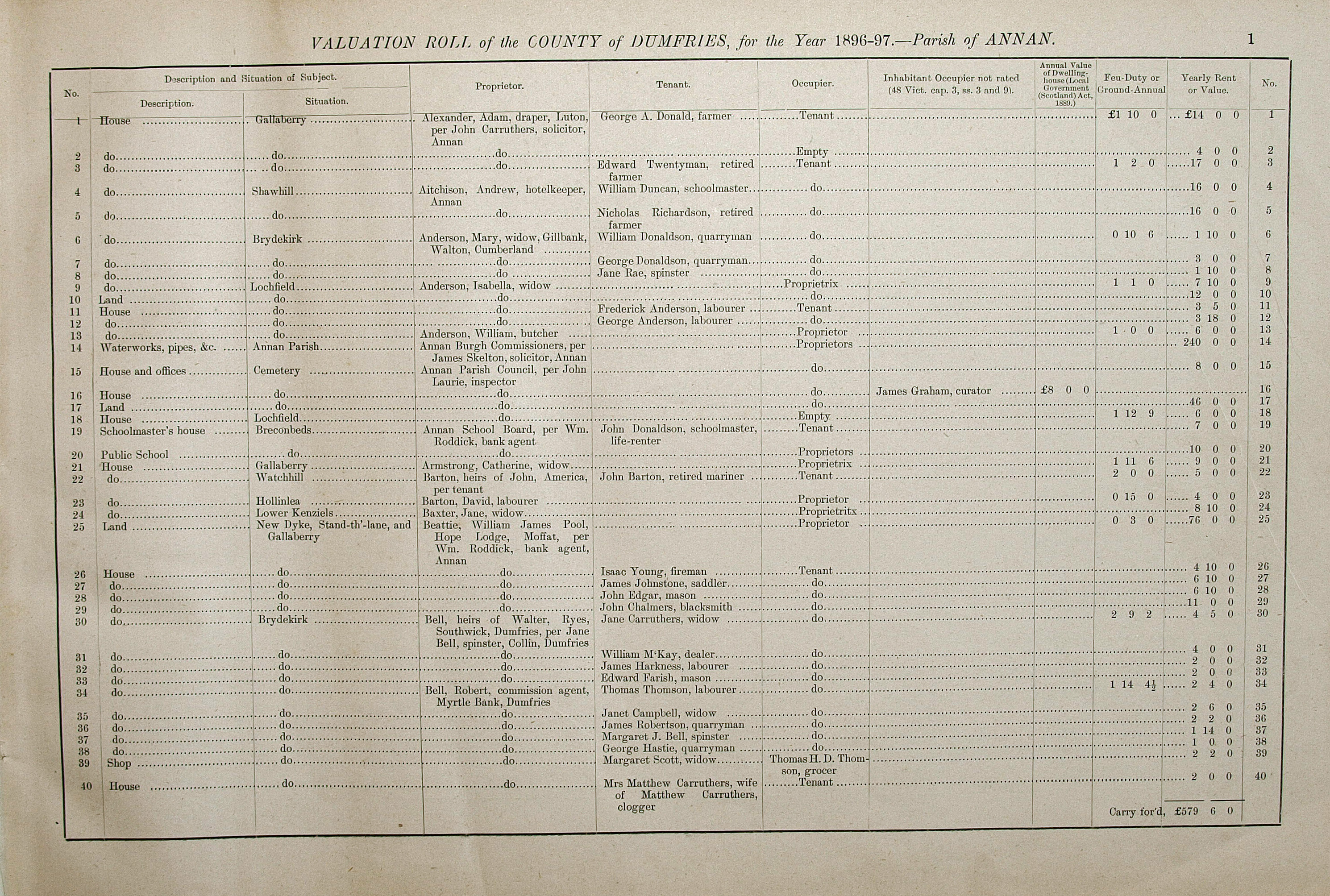
Valuation Roll, Annan, Dumfriesshire, Scotalnd (1896-97)

In general, you are more likely to find records of farmers and shepherds than agricultural labourers. This is because the farmer would often sublet the cottages on a farm to workers, in fact, the cottage would probably come with the job. In this case, your ‘Ag Lab’ may not appear in the estate records. Having said that, records of this nature vary so if you are up against a brick wall it may be worth checking.


Step one is to find out the name of the estate and who owned it. There are a few ways to go about this. One way is to look at the Valuation Rolls, some of which are on ScotlandsPeople. They will tell you who owned a property, who was the tenant and who lived in it. Not all small properties are listed in the early years and they only go back to 1855. Although they were produced yearly, ScotlandsPeople has generally added the volumes ‘between the census years’ like 1855, 1865, 1875 etc. 


Another way to find out is to search the newspapers, this is particularly helpful for farms. If a farm was available for rent it will be listed in the newspaper and tell you which estate it was on. This is also interesting as it will tell you a bit about the land your ancestors farmed. 


Maps from the National Library of Scotland can also be very helpful. Ordnance Survey maps are good but there are also a growing number of estate maps available: https://maps.nls.uk/estates/


The Register of Sasines records heritable property being transferred.
In some cases, you may need to use property records. As these are not online, I try to use the other means already mentioned, but here is some information about Scottish property records:
https://www.scottishindexes.com/learningsasines.aspx


Once you know which family owned the farm you can search for their estate records. The National Records of Scotland and National Library of Scotland both have large collections so they can be a good place to begin. 


Archives across Scotland also have their own collections of estate records. Either go to the archive for the area your ancestor lived or search the Scottish Archive Network catalogue: https://www.scan.org.uk/.


The National Register of Archives is another good place to look. The National Register of Archives for Scotland (NRAS) was established by the Scottish Record Office (now the National Records of Scotland) in 1946 to compile a record of papers of historical significance in private hands in Scotland. You can search this catalogue here: https://catalogue.nrscotland.gov.uk/nrasregister/welcome.aspx


One thing to remember is that often these records still belong to the family. Think of your small family archive, perhaps you have photographs of your great-grandparents or letters written to your granny. These are precious and belong to your family. Even if the letter mentions somebody else it’s still your letter and it’s up to you how it is used. It’s the same with estate records, they still belong to the family. Many estates allow access but they are not public records. This means that some may have restrictions on copying and publication. Make sure you find out what these are. 


Wednesday, 27 April 2022

Robbie Collins - an Eccentric Vendor

Today we have another story from John B. Drylie’s book, “Worthies of Dumfriesshire”

"Poor Robbie Collins, who was known far and near as a vendor of stationery and smallwares, was buried in Troqueer Churchyard in March 1830. Although he had no secret hoard like Wull Steenie [I will tell you more about Wull in another post], his books and clothes, when turned into money after his death, sufficed to lay his head decently in the grave, even to leave a balance, which was handed to the treasurer of the Kirk session, so that in one respect he was on a par with miser Wull, and though a pauper himself, he left a legacy to the poor.


Robbie was a native of Ayrshire, and at one time in his varied and chequered career he taught a small school in some Highland island. He was short of stature, lame of a leg, blind of an eye, and decrepit in mind as well as in body, and it was said that he had a "spice of the knave in him as well as the fool." He migrated to Dumfries about the year 1813, at which time he was possessed of only a few shillings. Gradually acquiring credit, however, with booksellers and other tradespeople, he traded his way so successfully that he at last grew rich, at least comparatively for a man of his grade, and he was able to deposit in the parish bank a sum little short of £70. His "round" was travelled very cheaply. Although most extensive, he visited many thousands of people in the east as well as the south of Scotland, and there were few who grudged him a bed or a meal; indeed there were many who patronised Robbie when they could have purchased more cheaply elsewhere. Robbie had a fawning, winning manner, and as a "character" he was favoured by the rich as well as by the poor.


As times prospered the box slung behind his back was exchanged for a pair of panniers, which, when filled with smallware, were mounted on a donkey's back, and Robbie, who had limped many a weary mile, thenceforward made his rounds more at his ease, and indeed quite like "the gentleman." By some means or other he fastened a printed label in verse on the donkey's forehead, which served for a sign wherever he went, by intimating the owner's name and occupation, and enumerating the various articles he had for sale.


Robbie had many a sore contest with his cuddy, which he designated as "a dour, thrawn, contrary beast," and though he frequently tried to reason with it in set speeches by the wayside, his eloquence was entirely thrown away. Nothing, however, could disabuse Robbie's mind of the notion that the ass understood every word he said. and as he was an enemy to every form of corporal punishment, he endeavoured by gentle and lenient means to train it in the way that cuddies should go. But, like many other reformers, even of the present day, his plans were too Utopian, and in the end he procured a cudgel, and discovered that this argument was the only sort of logic fitted to make an impression on the long-eared tribe.


Robbie's success in some measure "turned his head." Tired of wandering, nothing would serve him but a little shop, and ultimately he secured one in Church Place, Dumfries. This he furnished with all sorts of small gear under the sun, and, as he had the capital to begin with, he obtained plenty of credit. His arrangements being completed, he sent for the cuddy, got it hoisted up the stair of the shop, and then desired the wondering beast to look round on all the grandeur and tell him "what it thought of Collins now?" The speculation, unfortunately, failed, and, but for the kindness of a benevolent gentleman who allowed him a pension of six shillings per week for many years, he would have been reduced to the greatest penury and distress. Thus secured, however, he made long sweeps east and north, and was as well known in Edinburgh as he was in Dumfries. At one time he contemplated visiting France, and talked of drawing his pension on the other side of the Channel, and spending his days tranquilly in some sequestered corner of the finer climates of the south, and where, as he said, provisions were cheap, and the taxes a trifle.


On another occasion he conceived the idea of making his fortune by marriage. He had set his fancy on two fair dames whose merits were on a par, and between whom he was as much divided as his cuddy would have been between two bundles of hay. To both of these ladies he wrote letters filled with all sorts of honeyed words, and determined to be the bearer of his own dispatches, and, as the ladies lived in the country (in the parish of Irongray to be exact), he commenced his wooing as the crow flies - that is, he called at the nearest house first, and delivered his epistle in due form. At first the family took the matter seriously, but speedily relaxing, they merely laughed at Robbie, and instructed the servants to regale him in the kitchen. Collins "took the bite and the bat with it,” and then wended his way a mile or so further. As luck would have it, it so happened that the lady Collins first addressed was invited to tea at his second house of call, and as she travelled faster than her suitor, she got there before him. Of this the "braw wooer" knew nothing, and great was the merriment when the young ladies compared notes (for the first letter had been carried to the home of Robbie's last hope as a curiosity), and found that the second letter was a facsimile of the first. The "Laird o' Cockpen" had only one string to his bow, but Robbie had two, and yet he was unsuccessful. Another meal was all the poor man got for his pains, and he departed as much crestfallen as his great prototype, and perhaps he said or sung, as he walked or rode through the glen, "they were daft tae refuse Robbie Collins.""


Tuesday, 12 April 2022

Why did you start tracing your family tree and why would you encourage others to start?

Here are five 5 reasons I think people should ask about their family history this weekend; there are many more I am sure!


Want to make a start? Use our free guide to help you get started:
https://www.scottishindexes.com/learningdetective.aspx 


One

It’s a great puzzle! Great fun. As you learn more it’s as if your jigsaw gets bigger and bigger. There are more pieces to find and more puzzles to solve. Some are easy; some are more challenging. If you love puzzles you will love family history! Is there a family mystery you want to uncover?


Two

It helps you understand your relatives. As you talk to your family about their life you learn more about them. More than that, though, you can learn more about the family you never met. Finding out about a great-grandmother could help you understand your parent’s childhood; the life experiences that shaped them. 


Three

It stimulates thinking and long-term memories. Sadly as we age our short term memories can suffer. This can make conversations difficult with older people. Asking them about their childhood can stimulate long-term memories and lead to an enjoyable conversation. Of course, some may not want to talk about it. Always be kind and considerate of other people's feelings. 


Four

It’s a great way to learn about history. We may know the basics of history but discovering your ancestor's place in the past gives you a whole new perspective. Were they some of the weavers who rioted due to low wages in the early 1800s? Did they leave Ireland during the great famine? Were they interviewed as part of a Royal Commission report into housing? Did they witness King George IV visit Edinburgh in 1822? Were they moved from their home as part of the Highland Clearances? Whatever part your ancestors played in the past they are part of history.


Five

Discover more about the place where you live. If you still live in the area your ancestors lived in, you may be surprised by what you discover. Did your children go to the same school as your great-great-grandmother? Is the house they live in still standing? If you are planning a trip to Scotland, knowing where your ancestors lived, even the house they lived in, can make the experience so much more enjoyable. 


Want to make a start? Use our free guide to help you get started: https://www.scottishindexes.com/learningdetective.aspx 


Friday, 2 April 2021

Scottish Marriage by Declaration - Irregular Marriage - Sheriff Court Records

While you are researching your Scottish family history you will come across different wordings in the civil marriage registers (marriage certificates) that begin in 1855. These are the ‘Statutory Registers’ which you can search on ScotlandsPeople.

You may have seen, “After Publication according to the Forms of the Church of Scotland/Free Church/United Presbyterian Church of Scotland/Roman Catholic Church”. 


You may also see, ‘By Declaration in the presence of [names of witnesses].” In these cases, you will also see, “Warrant of the Sheriff Substitute of the [name of Sheriff Court]”.


I am including an image from ScotlandsPeople, which shows both of these types of entry on the same page. What’s the difference? Why is there a difference? Will the Sheriff Court records tell me more?


Until the mid-twentieth century, you could marry in Scotland by declaration. What does this mean? Basically, you said in front of witnesses that you were married and that was it; you were married. This was also known as an ‘irregular marriage’ (sometimes also referred to as a clandestine marriage) as opposed to a ‘regular marriage’ when a minister (or clergyman) performed the service.


An irregular marriage was quicker to arrange as the banns were not read. Although used by people throughout Scotland, it was perhaps the convenience of the marriage, along with the lower age requirement for marrying in Scotland without parental consent, that made places like Gretna Green on the border with England so popular for ‘runaway weddings’.


Both of these types of marriage were legal. The Church did not approve of irregular marriages and for that reason these frequently appear in Kirk Session records, but that’s a subject for another day.


Before 1855, when civil registration began, couples could declare in front of witnesses that they were married and that was that. 


After 1855, this type of marriage by declaration continued, but how was it to be recorded? To have the marriage registered the couple went to the Sheriff Court to receive a warrant. That warrant authorised the registration of the marriage.


Looking back at the marriage register is helpful here. We often make a dash for the names and dates but always take time to look at the headings. In the case of an irregular marriage, we see under the heading ‘When, Where and How Married’, the words ‘By Declaration in the presence of [names of witnesses].’


Another column heading is ‘If a regular Marriage, Signature of officiating Minister and Witnesses. If irregular, Date of Conviction, Decree of Declarator, or Sheriff’s Warrant.” Again in the case of irregular marriage, we usually see it completed, ‘Warrant of the Sheriff Substitute of the [name of Sheriff Court]’.


Are there corresponding records kept by the Sheriff Court?


Yes. These can be helpful, but not usually. Surviving records are generally found in the ‘Diet Books’ or ‘Minute Books’ of the sheriff court and are usually quite brief. In the example shown here, we see that the only extra information we are given is a bit more detail about the witnesses. I would never say not to follow the paper trail, just don’t get your hopes up.


Of course, there are often surviving church marriage registers post-1855 too which are occasionally useful. In general though, the information in the marriage register you can easily access on ScotlandsPeople will tell you just as much, if not more, than the corresponding church records. If you are up against a brick wall and can visit the National Records of Scotland, look at everything you possibly can.


Were all irregular marriages after 1855 registered?


There is evidence that they were not. I would like to do further study into this but occurrences in the Kirk Session minutes of the parish of Canonbie have been noted where a couple were reproved by the Kirk for being irregularly married and no corresponding record can be found in the marriage registers on ScotlandsPeople. 


Keep learning about Scottish genealogy by attending our free Scottish Indexes Conferences. The next is scheduled for 23 October 2021.


Tuesday, 12 January 2021

Tips for finding our ancestors in the 1911 census


As many of you will know the 1911 census for Scotland is not available on Findmypast or Ancestry. The Orkney 1911 census has been transcribed and is available from the Orkney FHS.

This means that we have to use the census on ScotlandsPeople which is a pay-per-view website. If we are researching a common name in a densely populated area we may have to look at many entries before we find the right one. 

How can we save those credits?

I will be sharing some tips at our conference on 30 January 2021 but here is one for you today.


Use Street Indexes

Before the census was available to public access, street indexes were prepared for large towns and cities. These can be helpful as they tell you which streets are in each registration district and even which census enumeration book. 

For example, earlier today I was searching for someone who I knew had been living at 272 Buchanan Street Glasgow in 1909. I wanted to work out from the ScotlandsPeople index (without paying anything) if any of the possible results could relate to 272 Buchanan Street.

First I went to the census street index for Glasgow and I was told that 272 Buchanan Street was in registration district number 644/8 and the relevant enumeration book was number 29.

Sadly you can’t use these reference numbers to search on ScotlandsPeople so I needed to work out what the name of registration district number 644/8 was in 1911. For rural areas, this isn’t such a problem but there are loads of districts in Glasgow, Edinburgh, Aberdeen and Dundee. It can all get a bit confusing. 

I now headed to the ‘Registration District guide - Glasgow’ which told me that in 1911 (very important to look at the date column) 644/8 was St. Rollox registration district.


I could now return to ScotlandsPeople and narrow down my search to St. Rollox. You can’t narrow it down to the enumeration book but we are looking for entries from 644/8 29. 


On ScotlandsPeople you will also see a page number as part of the reference number, for example we may see, ‘644/8 29/ 26’ This is registration district (RD) 644/8, enumeration book 29, page 26.


If I had originally thought that the entry with the reference 644/8 29/ 26 was 272 Buchanan Street, Glasgow, I would now know that it wasn’t and therefore I could save my credits for another search.


There are 1911 Census Street Indexes for the following places in Scotland:

Aberdeen

Ayr

Bonhill

Bothkennar, Grangemouth and Polmont

Bothwell, Holytown and Bellshill

Cambusnethan

Dalziel

Dumfries

Dunbarton

Dundee

Dunfermline

East and West Calder

Edinburgh

Falkirk

Glasgow

Greenock, Gourock and Port Glasgow

Hamilton

Hawick

Inverness

Kilmarnock

Kirkcaldy and Dysart

Lewis and Harris

Montrose

New Kilpatrick

New Monkland

Old Kilpatrick

Old Monkland - Western District, Coatbridge and Old Monkland - Eastern District

Paisley, Johnstone and Elderslie

Perth

Skye

St Ninians

Stirling

The Street Indexes are free from the National Records of Scotland here: https://www.nrscotland.gov.uk/research/guides/census-records/1911-census#Street%20indexes

The ‘Parishes and Registration Districts of Scotland by name’ guide (1.4 MB pdf) lists all parishes and districts in alphabetical order with the dates during which each was operative. There are also pages with further breakdowns of the cities of Aberdeen, Dundee, Edinburgh and Glasgow. See: https://www.nrscotland.gov.uk/research/guides/statutory-registers/registration-districts

I hope this helps you understand the referencing system a bit more and will hopefully save you some of those credits while you hunt for your ancestors. Hope you can join us at the next conference for more Scottish genealogy tips!


Tuesday, 26 March 2019

Top tips from the experts to keep your precious family photos safe for future generations!


Before and After - www.instarestoration.com
This is Peter Rosenkranz from InstaRestoration.com. We are a professional online photo restoration service with instant quotes. Our company repairs all kinds of different damages such as watermarks, scratches, cracks or even torn pieces. Simply upload your old family photo and we’ll do the rest. 

In this tutorial, I will explain to you how to properly archive your images to prevent such damage in the first place.

Around 80% of all the restoration work we are performing is related to family photos. What’s interesting about it is that around about 60% of these images have only suffered severe damage because of improper storage or display. This shows how important it is to archive your old family photos properly.

One of the first things you have to understand is that the process of decay is extremely slow. Improperly storing them won’t affect them today or tomorrow but eventually will have an impact. Just take a look at photographs from the early 20th century. It is almost impossible to find prints without any damage. Most of them have minor or even major damage. Compared to the length of your family’s history a 100 years is a blink of an eye. For saving these images for future generations to come it is crucial to apply some simple guidelines.

1. Temperature and Humidity

This one is the most important one. Your photographs have to be stored in a dry and cool place. Don’t store them like most people do, either on the attic or in the basement.
In the attic, high temperatures during summer cause your photograph to fade whereas the high humidity in the basement can lead to fungus and mould. These alterations are irreversible and can only be restored by a professional.

2. Use proper archiving material 

When buying archive boxes and sleeves always check whether they are acid and bleach free. Even paper boxes can include these harmful chemicals. Over time these substances slowly alter your photographs through chemical reactions. You might not see it straight away but think about the days and years your photographs stay in those boxes.

3. Photos only!

This sounds reasonable but you won’t believe how many times I have seen those kinds of damage. Photos have to be stored with photos only. Don’t put Grandma’s necklace or Grandpa’s ring into the same box as their photographs. Every time someone is moving that box these objects scratch the sensitive surface of your photographs. For the best protection put each photograph in an acid-free archive sleeve.

4. Ultraviolet light

Ultraviolet light is the number one reason for faded photographs. Always try to keep your original photographs out of direct sunlight. Think about how dangerous it can be to human skin, the same goes for photographs. If you like to display your old family photos in the living room or office use UV block glass or even better create a copy of that photo and store the original somewhere else.

5. Adhesives 

We have done it all at some point… I’m talking about those handy and easy to use sticky strips and other adhesives. As useful they might be as dangerous are the chemicals inside of them. Only use those sticky strips on reproductions of your photos, not the original ones.

6. Air Pollutants

Yeah, I know this one sounds silly but still it happens quite often. Don’t put your photo box in the same room as daddy stores his paint thinner or mommy her aggressive cleaning agent. What makes you dizzy makes your photographs dizzy as well.

7. Framing

This one comes in handy when you want to frame your photographs. First of all, think about whether you want to display an original print or not. If it’s an original photograph make sure to use UV blocking glass. Also, think about the possibility of the image becoming stuck to the frame’s glass. This sometimes happens because of fluctuating humidity during the seasons. And seriously this happening is pretty much the worst case scenario.
To prevent that either use frames with a distance between glass and print or put a special translucent plastic sheet between glass and image.

8. Labelling

Some of you like to label their old photographs. This actually makes sense for future generations to understand who that person is. But never use a ballpoint-pen, marker or one of these printable sticker labels. Again these all include chemicals that will slowly alter your photograph. The best and most gentle way to label your images is by using a very soft pencil.

9. Create digital copies

Last but not least create digital copies of your images, especially the ones which have already suffered damage. If worst comes to worst you still have a back up on your hard disk.

Before and After - www.instarestoration.com
Apply these simple steps and you're good to go. If any of your images are already damaged and you'd love to get them repaired or colourized check out our website.

www.instarestoration.com


Guest blog by Peter Rosenkranz

Tuesday, 28 August 2018

Breaking Down those Brickwalls: Scottish Sheriff Court Records

James Anderson - Crown copyright NRS SC5/8/434

An Amazing Discovery

We have found what may be one of our best discoveries ever! As evidence in an affiliation and aliment case (paternity case) there is an ambrotype (an early type of photograph) of the accused man dated pre-1860. It was bundled up in a box of court records.

The man pictured here is James Anderson, a wood carter who was living at Arbeadie Cottage, Banchory Ternan, Kincardineshire. (Click here to see the entry in our index - NRS, SC5/8/434). To make sure no damage comes to this amazing item the conservation branch at the National Records of Scotland have removed it from the bundle and work will now be undertaken to preserve this piece of history.

Example from another case NRS Ref: SC62/10/390

Court Records

For longer than we might expect, women have been taking the fathers of their children to court to compel them to pay maintenance for their children. In Victorian Scotland these cases were most often heard in the Sheriff Court. The most common type of case is ‘Affiliation and Aliment’, that is a case that proves ‘affiliation’ or paternity and decreed how much ‘aliment’ or maintenance should be paid by the father. If your ancestor was illegitimate their mother may well have taken the father to court.

Decree

At the end of most cases a decree would be made, this was legally binding. You could pay for an extract of the decree so that you could keep a copy. There were various reasons people might want an extract of a case but they were not always made.

From the 1830s most Scottish Sheriff Courts kept a volume of extracted decrees. So let’s say someone went to the court and asked for an extract, they would be given one and the court would write the extract into a book. We are indexing these books. See our coverage page here.

Processes

As well as the volumes of decrees the court would also keep the process, or paperwork, related to the case. These include witness statements and can include love letters. This week we found a case that included this ambrotype!

Birth Certificate

From 1855 all ‘affiliation’ cases which reached decree resulted in a correction being made to the register of births. This means that you usually know which court to start your search in. This particular case was settled, so it did not reach decree. This means that there is no note on the birth certificate naming the father of the child.

Indexing

With the help of a volunteer we are indexing the volumes of extracted decrees. Although these do not contain all cases, they do contain many of them. When a client orders a pre-1860 decree we let them know how many boxes we need to search to find the court process, or the more detailed paperwork. We charge £30 to search three boxes. As we search for the client’s case, we also note all other ‘paternity’ cases in the box and add them our index. If you would like us to search some records for you please get in touch.

This is what we were doing last Tuesday when we found the case that contained the ambrotype. The case can be seen here in our index. If you would like us to make a search for you just email me.

Brick Wall

Having an illegitimate ancestor is a major cause of family history brickwalls. We hope our indexing project will help break these down. If you would like us to search some boxes for you please just get in touch, I can’t promise to find a photograph for you but who knows what we will find!

Learn More

If you would like to learn more about Scottish Sheriff Court records or our indexing project, please see our Learning Zone.


Monday, 6 August 2018

Breaking Down those Brickwalls: Scottish Death Certificates


New Register House, Edinburgh

As is the case with birth and marriage certificates, 1855 is a great year from a genealogist's point of view.

In this first year of registration Scottish death certificates included the following information:

Date, time and place of death, usual residence, deceased's name, sex, marital status, age and occupation, the deceased's place of birth, spouse's name, both parents' names (including the mother’s maiden surname) and whether deceased, occupations and whether they were deceased, the names and ages of children (or age and year of death if the child pre-deceased the parent), cause of death, duration of last illness, doctor's name, when the doctor last saw the deceased alive, place of burial, the name of the undertaker and details of the informant.

Much of the bounty of information recorded in 1855 was sadly not continued after that year. From 1856-1860 you can expect to find the name, marital status, occupation, date, time and place of death and usual residence, full names of both parents and whether deceased, cause of death, duration of disease and doctor's name, place of burial and undertaker's name, and details of the informant.

Did you know?


By looking at your ancestor's death certificate between 1855 and 1860, or even that of a close relative such as a sibling, you may get a clue as to where the rest of the family were buried. If it was a family plot you may then be able to trace your ancestors using transcriptions of the gravestone, if it has survived. It’s not unusual to find three generations recorded on one gravestone!


Find out more about Scottish civil registration on our website: http://www.scottishindexes.com/learningcivil.aspx


Tuesday, 24 July 2018

Breaking Down those Brickwalls: Designations


To trace our Scottish family tree we begin by searching for birth, marriage and death certificates. Before 1855 we use church records but all too often we cannot find the records we need.

There are many reasons for ‘missing’ baptism records. It may be that the register was lost or damaged. By the mid 1800s, there were many different church denominations in Scotland, meaning you may need to look at many separate registers, not all of which are available online. To find out how to do this, visit our Learning Zone: Births, Marriages and Deaths in Scotland before 1855.

Even when you make a careful search, however, it may be that no baptism survives and you seem to have hit a brickwall in your research.

What we need to do now is be more imaginative, looking beyond the obvious records. In Scotland, a ‘designation’ is given in certain types of documents, particularly legal records. This designation was given to distinguish one person from another. At a time when many people did not know their date of birth and they certainly didn’t have a National Insurance (or Social Security number) or a postcode (or zip code), something was needed to identify the person mentioned in a document.

What is included in a Designation?


Generally, a designation will include the person’s name, residence and occupation. In the case of a child (and some adults) the father’s name may also be given along with his occupation and residence (it may also be stated that he is deceased). This information could help you get over a brick wall and continue on with your research.

Did you know?


A designation is the addition or description of a person. It is necessary in legal documents to design or identify the parties in such a manner as to distinguish them from all others; and in practice this was done by setting down the title of nobility, or the name and surname of the party, with his addition or description, by his estate, profession, trade, or place of residence. In certain instances it would also include the name of the party’s father.

The National Records of Scotland

Where do we find designations?


Legal records always give a designation. These may be criminal court records, wills and ordinary (civil) court records (such as ‘Actions of Affiliation and Aliment’) and sasine records (property records).

No matter what social class our ancestors were, there may be a legal record that survives and this could be the key we need to unlock our family tree.


Finding legal records


Wills are an easy place to start. Many Scottish wills are available on ScotlandsPeople and the index is free to search. You can search many sasine records (property records) in the National Records of Scotland.


We have indexed many Sheriff Court records and we update our index most weeks. You can search these for free (with no login or subscription) and just order the entry you need. Our index includes the designation. Click to see the entry for Agnew versus Carter in 1859, notice the pursuer is named as “Jane Agnew, daughter of and residing with John Agnew, Mason, Knockbrex, Penninghame”. We have also indexed some sasine records and deeds and we plan to add more.


Although prison registers do not generally give a ‘designation’ they do give an age and birthplace which can be helpful. The registers also tell us which court heard the case, and when the court records survive these give a designation. When you order a prison record from us we will tell you if there is (or may be) a corresponding court record. In fact generally, the person’s address is sufficient to identify which ‘John Smith’ we are talking about.

What to do next


Look over your family tree brick walls, which legal records might your family appear in? Did they own property, or were they more likely to end up in prison? Is there an illegitimate child in the family? Could there be a Sheriff Court record? Did your ancestor learn a trade? Then there may be an apprenticeship record.


Did you know?


Small words mean a lot!

‘Or’

Historically women were always recorded with their maiden surname in Scots legal documents. By the 19th century, it was the usual practice to record women with both maiden and married surnames in legal records. Let’s say our ancestor was born Margaret Scott and married James Thomson: we would expect to find her recorded as ‘Margaret Scott or Thomson’.

‘At’, ‘In’ and ‘Of’

The way the residence of a person is recorded is also important. The small words ‘at’ ‘in’, and ‘of’ all mean very specific things.

You can see the following example here on our website. “Aeneas McPherson of Flichity & Lachlan McIntosh in Nessendally” - Aeneas is described as ‘of Flichity’, the small word ‘of’ (instead of saying 'in' or 'at') shows that Aeneas McPherson had heritable possession of Flichity. This is a clue to more records. Lachlan, on the other hand, is described as “ Lachlan McIntosh in Nessendally” meaning Lachlan was a tenant of those lands.

In other records a person may be described as ‘at’ a place, this would indicate they were an occupier, not a tenant or owner.


Understanding these small, but significant words, can unlock your family tree. If you need more help just get in touch.

Monday, 5 February 2018

Brickwall Service


Our 2-hour brickwall service is proving very popular. Most people find that on one of their lines they hit a brick wall. It may be that our experience or the access we have to Scottish records is just what you need to break through the brick wall and continue with your journey. If you have a brick wall why not give it a try, you could open up a whole new chapter of your family history. Either email me (just reply to this email) or look at our website for more information.


Saturday, 3 February 2018

Was Your Ancestor a Convict?


Every year the Scottish Association of Family History Societies (SAFHS) hold a conference and family history fair. This year the theme is, "Was Your Ancestor a Fife Convict?"

The annual event will take place this year on 21 April 2018 at the Rothes Halls, Glenrothes, Fife. 

One of our genealogists, Emma Maxwell, will be giving the talk, “Finding Your Ancestors' Footprints” and all the talks will revolve around the theme of criminal records. 

As well as the four talks there will be a free ‘Ask the Expert’ area, hosted by the Scottish Genealogy Network. It will be a great opportunity to get some professional advice on how to trace your family history.

To find out more and book your ticket go to the SAFHS 2018 website. 

If you need help to find out what life in Scotland was like for your ancestors get in touch and see how we can help.


Friday, 2 February 2018

Free Scottish Genealogy Tutorials

We are creating free family history tutorials to help you trace your Scottish family tree.

Our first tutorial will show how to find your ancestors on historical maps, using our website.


Our second tutorial demonstrates how to use 'wildcards' to find those ancestors who never seem to spell their name the same way twice!


Subscribe to our YouTube channel so that you don't miss the next tutorial.

Thursday, 1 February 2018

Glasgow Docklands 1956 - What was life like?

The National Library of Scotland's moving image archive has thousands of clips and full-length films from across Scotland. They are a great way to get a sense of what Scotland was like in the past and this can help you to research your Scottish family tree.

For example, we love this video showing everyday life in 1956. From the Docklands to the Kelvingrove Park this video shows wonderful footage of Scotland.

From tugs on the Clyde, warehouses on the wharf, coals for export, children playing in the slums, feeding the ducks in Kelvingrove park and children playing in the streets this 10-minute video will draw you back in time.

Hear a young girl reciting this children's rhyme that your ancestors likely sang while they played with their skipping rope.

Oh there she goes,
Oh there she goes,
Peerie heels and pointed toes.
Look at her feet, she thinks she's neat,
Black stockings and dirty feet

If you need help to find out what life in Scotland was like for your ancestors get in touch and see how we can help.


Friday, 4 August 2017

Press Release - 40,000 ‘Lunatics’ - Scottish Genealogy Website Enables People to Discover the True Lives of their Ancestors

Logo with words purple 10cm 72dpi.jpg
FOR IMMEDIATE RELEASE

40,000 ‘Lunatics’ - Scottish Genealogy Website Enables People to Discover the True Lives of their Ancestors

4 August 2017

Glasgow, Scotland – Today Scottish genealogy website www.scottishindexes.com move another step closer to their goal of indexing all historical Scottish mental health records from 1858 to 1915. This release means the index now has 40,000 entries from across Scotland and includes people from every walk of life.


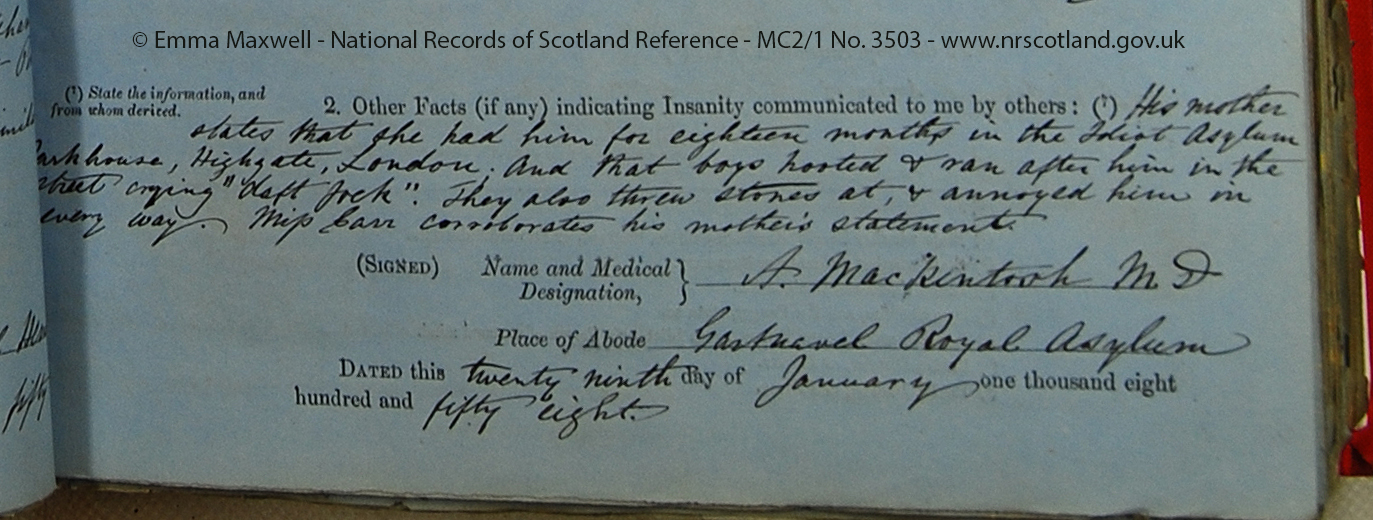
Admission forms for John Rae Thomson MC2_1 No. 3503 image 3 section _ Facts indicated by others_ the boys called him “daft feck”.jpg
John Rae Thomson - Facts Indicated by Others - “His mother states...that the boys hooted & ran after him in the street crying “daft Jock”. (More images available in the press kit)

These historic mental health records give the story behind the facts. A census record may tell you that your great-grandmother was in an asylum, but not why she was there and that’s what we really want to know. This project, lead by Scottish Indexes, is supported by a growing team of volunteers.


Emma Maxwell, genealogist at Scottish Indexes says, “Our mission is to help people not only research their Scottish family tree, but also understand the lives of their ancestors.”
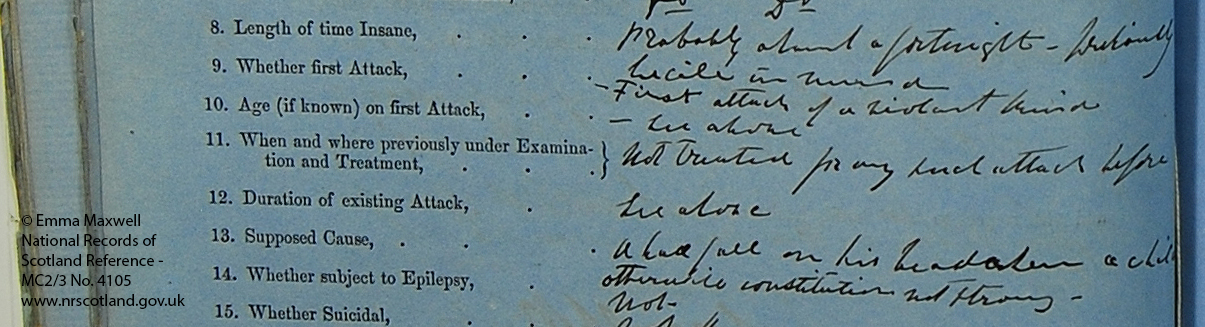
MC2_3 No. 4105 page 2 _ Question 13_ Supposed cause _  A fall on his head as a child.jpg
George Patrick Baillie - Supposed cause -  A fall on his head as a child (More images available in the press kit)


The records being indexed by Scottish Indexes are held by the National Records of Scotland (NRS) in Edinburgh. Without an index they are hugely time-consuming to search and access to the records would usually mean a trip to Edinburgh. These records contain not just names, dates and places but personal information. For example the admission form of John Rae Thomson tells us that the supposed cause of his mental health problems was ‘Premature Birth’. The same record gives his mother’s account of how boys tormented this poor 26 year-old.


Viv from Scotland says, "Although I knew that some of my relatives were in mental health institutions, the indexes at Scottish Indexes and linked original records have allowed me to find out far more about their stories. I feel that I know so much more about these people, and the information is invaluable."


Ailsa from Australia says, “I have been using Scottish Indexes for quite some time now and found many references to my own family within them. They are great for me to use from Australia.”

ENDS

For further information please contact:
Emma Maxwell, Genealogist, Scottish Indexes, info@scottishindexes.com


Notes to the Editor


  • We have prepared a press kit containing 15 images which can be used across all media platforms (download here: www.scottishindexes.com/press_kit.zip). These show full pages of the records and we have selected certain interesting sections of each page which we thought would be of particular interest to your readers. Each is embedded with a copyright statement (approved by the NRS) for your convenience. The examples given can be found in our index: MC7/1 p. 168  - John Rae Thomson and MC7/1 p. 173 - George Patrick Baillie


  • www.scottishindexes.com is run by Scottish genealogists Graham and Emma Maxwell, a husband and wife team based in East Kilbride, Glasgow, Scotland. Indexes are created by Graham and Emma with the help of a team of volunteers. All indexes are free to view and the National Records of Scotland (NRS) reference is given so users can either access the documents without charge at the NRS, or purchase the service from Scottish Indexes.