If your ancestor was a farmer, shepherd or agricultural labourer you may be able to find information in estate records.
Families who owned large estates would need their own records. These might record who were their employees, or who rented their farms. These records can be useful when you are researching your family history. For example, it’s not unusual for a farm to be rented by generations of the same family. This can be crucial information for periods when there are no census records or there are gaps in church records.
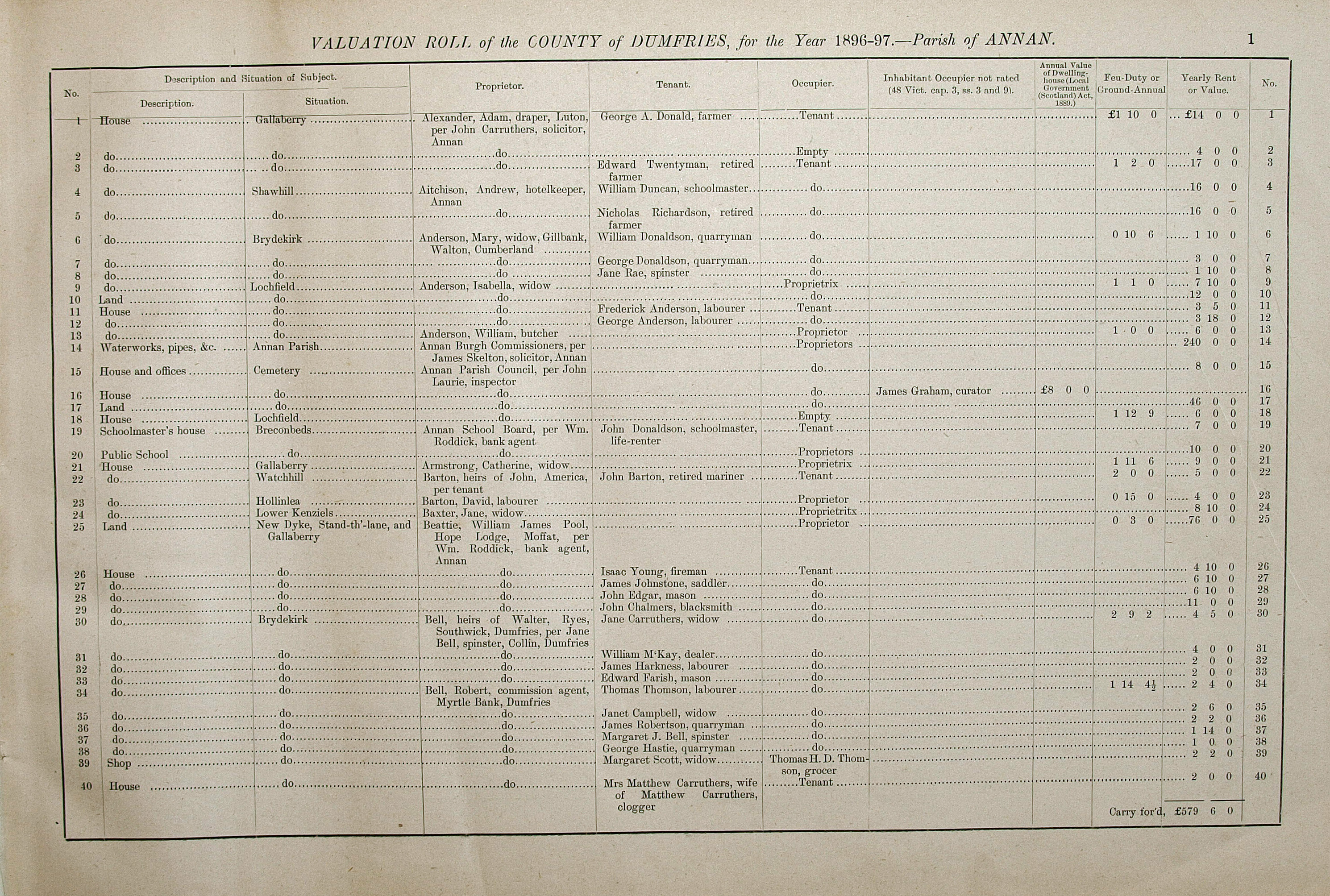 |
| Valuation Roll, Annan, Dumfriesshire, Scotalnd (1896-97) |
In general, you are more likely to find records of farmers and shepherds than agricultural labourers. This is because the farmer would often sublet the cottages on a farm to workers, in fact, the cottage would probably come with the job. In this case, your ‘Ag Lab’ may not appear in the estate records. Having said that, records of this nature vary so if you are up against a brick wall it may be worth checking.
Step one is to find out the name of the estate and who owned it. There are a few ways to go about this. One way is to look at the Valuation Rolls, some of which are on ScotlandsPeople. They will tell you who owned a property, who was the tenant and who lived in it. Not all small properties are listed in the early years and they only go back to 1855. Although they were produced yearly, ScotlandsPeople has generally added the volumes ‘between the census years’ like 1855, 1865, 1875 etc.
Another way to find out is to search the newspapers, this is particularly helpful for farms. If a farm was available for rent it will be listed in the newspaper and tell you which estate it was on. This is also interesting as it will tell you a bit about the land your ancestors farmed.
Maps from the National Library of Scotland can also be very helpful. Ordnance Survey maps are good but there are also a growing number of estate maps available: https://maps.nls.uk/estates/
In some cases, you may need to use property records. As these are not online, I try to use the other means already mentioned, but here is some information about Scottish property records: https://www.scottishindexes.com/learningsasines.aspx
The Register of Sasines records heritable property being transferred.
Once you know which family owned the farm you can search for their estate records. The National Records of Scotland and National Library of Scotland both have large collections so they can be a good place to begin.
Archives across Scotland also have their own collections of estate records. Either go to the archive for the area your ancestor lived or search the Scottish Archive Network catalogue: https://www.scan.org.uk/.
The National Register of Archives is another good place to look. The National Register of Archives for Scotland (NRAS) was established by the Scottish Record Office (now the National Records of Scotland) in 1946 to compile a record of papers of historical significance in private hands in Scotland. You can search this catalogue here: https://catalogue.nrscotland.gov.uk/nrasregister/welcome.aspx
One thing to remember is that often these records still belong to the family. Think of your small family archive, perhaps you have photographs of your great-grandparents or letters written to your granny. These are precious and belong to your family. Even if the letter mentions somebody else it’s still your letter and it’s up to you how it is used. It’s the same with estate records, they still belong to the family. Many estates allow access but they are not public records. This means that some may have restrictions on copying and publication. Make sure you find out what these are.