Showing posts with label National Library of Scotland. Show all posts

Tuesday, 3 May 2022

Did your ancestors work the land?

If your ancestor was a farmer, shepherd or agricultural labourer you may be able to find information in estate records. 


Families who owned large estates would need their own records. These might record who were their employees, or who rented their farms. These records can be useful when you are researching your family history. For example, it’s not unusual for a farm to be rented by generations of the same family. This can be crucial information for periods when there are no census records or there are gaps in church records.
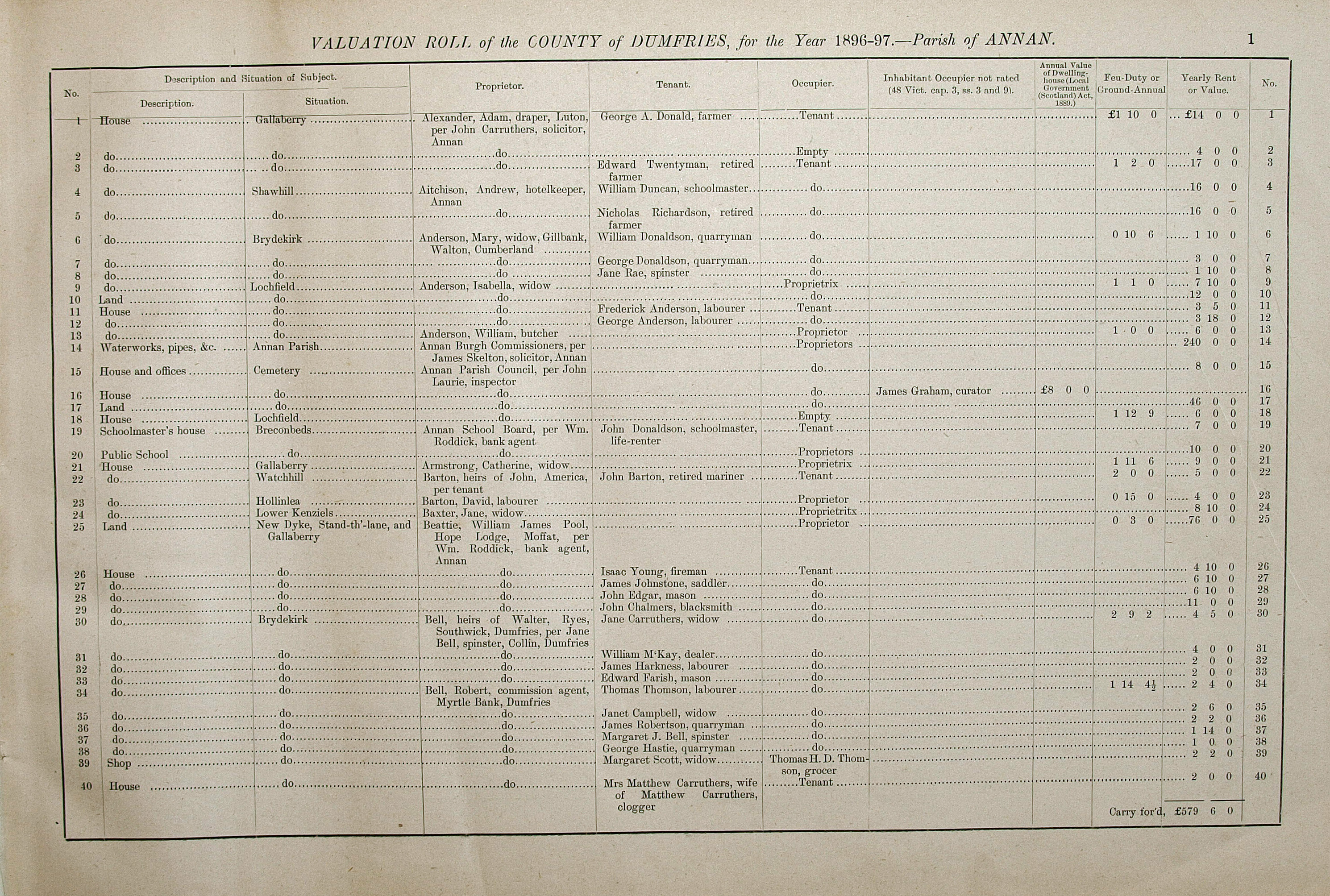
Valuation Roll, Annan, Dumfriesshire, Scotalnd (1896-97)

In general, you are more likely to find records of farmers and shepherds than agricultural labourers. This is because the farmer would often sublet the cottages on a farm to workers, in fact, the cottage would probably come with the job. In this case, your ‘Ag Lab’ may not appear in the estate records. Having said that, records of this nature vary so if you are up against a brick wall it may be worth checking.


Step one is to find out the name of the estate and who owned it. There are a few ways to go about this. One way is to look at the Valuation Rolls, some of which are on ScotlandsPeople. They will tell you who owned a property, who was the tenant and who lived in it. Not all small properties are listed in the early years and they only go back to 1855. Although they were produced yearly, ScotlandsPeople has generally added the volumes ‘between the census years’ like 1855, 1865, 1875 etc. 


Another way to find out is to search the newspapers, this is particularly helpful for farms. If a farm was available for rent it will be listed in the newspaper and tell you which estate it was on. This is also interesting as it will tell you a bit about the land your ancestors farmed. 


Maps from the National Library of Scotland can also be very helpful. Ordnance Survey maps are good but there are also a growing number of estate maps available: https://maps.nls.uk/estates/


The Register of Sasines records heritable property being transferred.
In some cases, you may need to use property records. As these are not online, I try to use the other means already mentioned, but here is some information about Scottish property records:
https://www.scottishindexes.com/learningsasines.aspx


Once you know which family owned the farm you can search for their estate records. The National Records of Scotland and National Library of Scotland both have large collections so they can be a good place to begin. 


Archives across Scotland also have their own collections of estate records. Either go to the archive for the area your ancestor lived or search the Scottish Archive Network catalogue: https://www.scan.org.uk/.


The National Register of Archives is another good place to look. The National Register of Archives for Scotland (NRAS) was established by the Scottish Record Office (now the National Records of Scotland) in 1946 to compile a record of papers of historical significance in private hands in Scotland. You can search this catalogue here: https://catalogue.nrscotland.gov.uk/nrasregister/welcome.aspx


One thing to remember is that often these records still belong to the family. Think of your small family archive, perhaps you have photographs of your great-grandparents or letters written to your granny. These are precious and belong to your family. Even if the letter mentions somebody else it’s still your letter and it’s up to you how it is used. It’s the same with estate records, they still belong to the family. Many estates allow access but they are not public records. This means that some may have restrictions on copying and publication. Make sure you find out what these are. 



Monday, 17 April 2017

Where did your Scottish Ancestors Live?

New Abbey Village
Once you have found your ancestor’s entry in the census you may decide to find out more about the house and the general area where they lived. Here are a few sources that could help you.

The National Library of Scotland has a great collection of Ordnance Survey maps available for free on their website. If your ancestors lived in a town the high detail 1:500 scale maps might even show trees in your family’s garden! 

 NLS: http://maps.nls.uk

The ScotlandsPlaces website can add another piece of the jigsaw. Available for free on their website are the ‘Ordnance Survey Name Books’. These volumes give information about placenames and building names on the first edition Ordnance Survey mapping which took place in the mid-19th century. They also give a description of each place. An example is East Lodge in Dumfriesshire, Volume 1, “A small cottage one story high slat[t]ed & in good repair. Occupied by Mary Dalziel who keeps the gate. It is the property of the Trustees of Hoddam Castle it being at the eastern entrance of Hoddam Demesne.” 

ScotlandsPlaces: www.scotlandsplaces.gov.uk

Scottish property records, called sasines, can also add more detail. Sasines are held by the National Records of Scotland and from 1781 there are indexed abridgements which can be searched by place or name. These give a description on the boundary of each property and often mention the neighbours in this description. Don’t expect to find plans though, or at least not in the older records. The extent of each property is usually described in words. 

NRS: www.nrscotland.gov.uk

Monday, 10 April 2017

Scottish Roman Catholic Parish Records


You can now access Scottish Roman Catholic Parish Baptisms, Marriages and Burials on FindMyPast. These have been available on ScotlandsPeople for a while but for those of us with the British subscription package to FindMyPast these Catholic records will be included in our existing package.

If you’re researching on a budget it’s worth asking if FindMyPast or other sites are available through your local library. One library they are available in is the National Library of Scotland. Also FindMyPast offer a free trial so this could be a great time to start tracing your Scottish family tree.

If you’ve been researching your family tree but you’re a little stuck, come to us and we can help you get over the brick wall and get your research back on track.

Wednesday, 22 October 2014

Conservation at the National Library of Scotland


When we reach for a book our primary thoughts are likely on the contents. Whether we're reading for pleasure or study, it's probably the title of a book that made us pick it up.


There are groups of people, though, who pick up books with a different perspective. One such group can be found on the fourth floor of the National Library of Scotland (NLS). The conservation department have a mission to preserve and protect the holdings of the NLS and they do so with great diligence.


Their aim is to ensure that items are able to be viewed by the public, and in some cases digitised so that we can all view them online. This brings in a great variety of skills, and their remit is wider than we may at first imagine.


The conservation team are not only responsible for fixing damaged items (and preventing damage) but also caring for items when vital maintenance is taking place on the buildings in which they are stored. We all enjoy the NLS exhibitions, but have you ever considered how long it takes to prepare the items? The items need to be able to be viewed in a display case, but without careful preparation, such a display could cause damage.


Talking to the team yesterday, they told me that one item could take a day to prepare. They may need to wash the paper, conserve damaged areas then design a method of keeping the item stable while on display. It could be a matter of attaching a piece of paper to a board, or designing a made to measure book stand so you can read it easily in a display.


The team are constantly working to improve conservation methods too. For example, a recent project to preserve a vellum book gave the conservation team the opportunity to develop a new method of flattening pages. The traditional method wouldn't work due to the severity of the damage to the book. In the end, they used a wet solution then laid the book on a suction table, gradually increasing the suction to flatten the pages, how ingenious!


This visit will certainly make me think differently the next time I see a library or museum display. I suppose though the question for us is, what can we do to help them, and help preserve books and documents that we consult while tracing our family tree?


There are obvious things, handle with care. Use a cushion or other support for books and don’t open them too far. If you open a book and hear the spine crack that’s the glue and thread ripping apart and YOU are shorting the life of the book.


 © Copyright Kim Traynor
I asked, if there is one thing to remember, what would it be? The answer, use clean hands. How simple, we can all do that, can’t we? When a celebrity goes to an archive on a TV programme they are invariably given white cotton gloves. In reality however we don’t often wear them. While they may stop oils from our skin transferring to the books, they actually increase the possibility of tearing the book or documents, especially if the paper is fragile. If we wash our hands, though, this will also limit the transfer if oils from our hands to the documents.


My tour was part of the conservation workshop. Keep an eye on the National Library of Scotland’s website for future tours: they are free but do need to be booked in advance. If you are part of a group that would like a tour, contact the NLS and they would be happy to arrange one for groups of up to 15 people.


Monday, 30 January 2012

A Midnight Adventure


Whilst researching in the National Library of Scotland today I came across this interesting tale:

A Midnight Adventure – A lady and a gentleman were disturbed in their slumbers one night last week by the very unpleasant noise of a slight move under the bed. The lady expressed alarm, but her somewhat sleepy caro sposo said, “Oh it is only one of the dogs,” and, putting his hand down by the side of the bed, his hand being licked, after a moment the pair were satisfied and they soon slumbered again peacefully. In the morning, however, they found that all their money and jewellery had disappeared, and it was clear that the lick had been the dernier ressort of an ingenious biped concealed under the bed – Court Journal.

Source: in the Montrose Standard and Angus And Mearns register, August 26th 1864, Page 3