Showing posts with label history. Show all posts

Wednesday, 27 April 2022

Robbie Collins - an Eccentric Vendor

Today we have another story from John B. Drylie’s book, “Worthies of Dumfriesshire”

"Poor Robbie Collins, who was known far and near as a vendor of stationery and smallwares, was buried in Troqueer Churchyard in March 1830. Although he had no secret hoard like Wull Steenie [I will tell you more about Wull in another post], his books and clothes, when turned into money after his death, sufficed to lay his head decently in the grave, even to leave a balance, which was handed to the treasurer of the Kirk session, so that in one respect he was on a par with miser Wull, and though a pauper himself, he left a legacy to the poor.


Robbie was a native of Ayrshire, and at one time in his varied and chequered career he taught a small school in some Highland island. He was short of stature, lame of a leg, blind of an eye, and decrepit in mind as well as in body, and it was said that he had a "spice of the knave in him as well as the fool." He migrated to Dumfries about the year 1813, at which time he was possessed of only a few shillings. Gradually acquiring credit, however, with booksellers and other tradespeople, he traded his way so successfully that he at last grew rich, at least comparatively for a man of his grade, and he was able to deposit in the parish bank a sum little short of £70. His "round" was travelled very cheaply. Although most extensive, he visited many thousands of people in the east as well as the south of Scotland, and there were few who grudged him a bed or a meal; indeed there were many who patronised Robbie when they could have purchased more cheaply elsewhere. Robbie had a fawning, winning manner, and as a "character" he was favoured by the rich as well as by the poor.


As times prospered the box slung behind his back was exchanged for a pair of panniers, which, when filled with smallware, were mounted on a donkey's back, and Robbie, who had limped many a weary mile, thenceforward made his rounds more at his ease, and indeed quite like "the gentleman." By some means or other he fastened a printed label in verse on the donkey's forehead, which served for a sign wherever he went, by intimating the owner's name and occupation, and enumerating the various articles he had for sale.


Robbie had many a sore contest with his cuddy, which he designated as "a dour, thrawn, contrary beast," and though he frequently tried to reason with it in set speeches by the wayside, his eloquence was entirely thrown away. Nothing, however, could disabuse Robbie's mind of the notion that the ass understood every word he said. and as he was an enemy to every form of corporal punishment, he endeavoured by gentle and lenient means to train it in the way that cuddies should go. But, like many other reformers, even of the present day, his plans were too Utopian, and in the end he procured a cudgel, and discovered that this argument was the only sort of logic fitted to make an impression on the long-eared tribe.


Robbie's success in some measure "turned his head." Tired of wandering, nothing would serve him but a little shop, and ultimately he secured one in Church Place, Dumfries. This he furnished with all sorts of small gear under the sun, and, as he had the capital to begin with, he obtained plenty of credit. His arrangements being completed, he sent for the cuddy, got it hoisted up the stair of the shop, and then desired the wondering beast to look round on all the grandeur and tell him "what it thought of Collins now?" The speculation, unfortunately, failed, and, but for the kindness of a benevolent gentleman who allowed him a pension of six shillings per week for many years, he would have been reduced to the greatest penury and distress. Thus secured, however, he made long sweeps east and north, and was as well known in Edinburgh as he was in Dumfries. At one time he contemplated visiting France, and talked of drawing his pension on the other side of the Channel, and spending his days tranquilly in some sequestered corner of the finer climates of the south, and where, as he said, provisions were cheap, and the taxes a trifle.


On another occasion he conceived the idea of making his fortune by marriage. He had set his fancy on two fair dames whose merits were on a par, and between whom he was as much divided as his cuddy would have been between two bundles of hay. To both of these ladies he wrote letters filled with all sorts of honeyed words, and determined to be the bearer of his own dispatches, and, as the ladies lived in the country (in the parish of Irongray to be exact), he commenced his wooing as the crow flies - that is, he called at the nearest house first, and delivered his epistle in due form. At first the family took the matter seriously, but speedily relaxing, they merely laughed at Robbie, and instructed the servants to regale him in the kitchen. Collins "took the bite and the bat with it,” and then wended his way a mile or so further. As luck would have it, it so happened that the lady Collins first addressed was invited to tea at his second house of call, and as she travelled faster than her suitor, she got there before him. Of this the "braw wooer" knew nothing, and great was the merriment when the young ladies compared notes (for the first letter had been carried to the home of Robbie's last hope as a curiosity), and found that the second letter was a facsimile of the first. The "Laird o' Cockpen" had only one string to his bow, but Robbie had two, and yet he was unsuccessful. Another meal was all the poor man got for his pains, and he departed as much crestfallen as his great prototype, and perhaps he said or sung, as he walked or rode through the glen, "they were daft tae refuse Robbie Collins.""


Monday, 18 April 2022

Lawrence Murphy — what a chancer!

‘Worthies of Dumfriesshire and Galloway’ was written by Jon Drylie and published in 1908. It is similar to other publications of the period, giving a biography of various characters in the area. Today’s story is that of Lawrence Murphy aka, ‘Tarry Larry’. The challenge for us as family historians is to separate fact from fiction.


Some research shows that Larry died in April 1902 in Dumfries Poorhouse. His age is recorded as 101; is this correct? I started doing some digging and on Findmypast I discovered Lawrence Murphy in the Merchant Seaman records. We’re told that he first went to sea as an apprentice in 1835 and that he was born on 10 March 1822. This is a long way off his date of birth being around 1800.


I checked Scotland's Criminal Database on Scottish Indexes and discovered that Lawrence was no stranger to the prison at Dumfries. In 1841 his age was recorded as 20, which was about right. Eight years later in 1849 he’s only 6 years of age. By 1857 he’s only 42 and by 1868 he was claiming to be born in 1811. This age massaging continues. By the census of 1891, when he was living in the poorhouse, his age was recorded as 88, giving him a birth year of 1803/4. Somehow by the time he died he had managed to increase his age again! 


Bear these facts in mind as you read the chapter, ‘Tarry Larry’ from ‘Worthies of Dumfriesshire and Galloway’, written by John Drylie.


“Lawrence Murphy, who lived till he was over 100 years of age, and who died only a few years ago, was a native of Dumfries, and in the twentieth century he could relate to the smallest detail his recollections of the French prisoners in Dumfries at the beginning of last century. With them he was on intimate terms, and acted as a sort of page boy. For them he made excursions to Lochar Moss and the Long Wood for puddocks, frogs, and hedgehogs, on which the French officers would dine. Larry, as he was familiarly called, took to a seafaring life in his early days, and for almost half-a-century he followed that vocation, during which time he saw a good deal of the surface of the globe. He sailed a lot between Canada and Britain, and he used to say that "the very dogs in Quebec knew him."


Once when sailing on the "John Wilson," which was bringing home timber from Quebec, and which belonged to Laird Thomson, commonly called "the Laird," the skipper of the bark refused to allow the sailors the usual allowance of "grog." The weather was bitterly cold at the time, and "Larry," who was generally the ringleader in any adventure, undertook to supply the crew with a share of the special brandy which was contained in a big jar enclosed in a wicker case for the Laird's delectation. Larry's "modus operandi" was as follows. Cute enough not to touch the seal he turned the jar up-side down, and boring a hole into it, he extracted the liquor, which was substituted by salt water, the hole plugged up, and the jar returned to its proper place. The Laird naturally was amazed at the transformation of his wine into salt water, and he thought that the agent at Quebec had played a practical joke upon him. It was a year after that before Larry found occasion to explain the real reason for the disappearance of the liquor. He was rafting timber on the Nith at the foot of Bank Street, and when the Laird unwarrantably "yoked on " Larry, the latter took the Laird off with the remark - "Hech, ye needna be sae bubbly; we did ye wi' the brandy last year."


During his seafaring career, Larry was an adept at smuggling tobacco. He had no faith in the stereotyped false-bottomed chests, or any her worked-out fakes, but like Myles Crow, he was original in his ideas, and fortunately or unfortunately as readers may think, Larry was more successful than that unfortunate whom we met in a previous chapter. Sometimes Larry would tie the tobacco into a tight bundle, climb to the truck of the mast, secure the bundle there with a cord, and remove it from its lofty resting-place on the quiet. Another plan was to put the weed into an old canvass bag, tie it round and round with ropes, and then besmear the whole with tar. It is needless to say that such an article got little investigation from the officers of excise.


Tired of the sea, Larry settled down in Dumfries, and was principally employed rafting on the river. He had a constitution of iron, and was devoid of all fear. About sixty years ago the scaffolding at the Martinton Railway Bridge, on the Castle Douglas Railway, which was then being built, was carried down the Nith by a flood, and a considerable quantity of it was stopped by the piers at the New Bridge, Larry was swung from the bridge by a waistband and a rope, and by this means he tied ropes to the planking and machinery swirling in the flood below, which were then drawn safely to the side. Larry might be said to have been a water-kelpie. On one occasion someone, by way of a joke, had nut an advertisement in the newspapers stating that on a certain day an American diver would dive into the Nith from the Old Bridge. A large crowd of people turned out to witness the exhibition, but the Yankee failed to appear, and Larry, always ready to please, said: "We'll no see folks cheated; I'll dae't mysel'." Thereupon, Larry, fully dressed, dived from the Bridge to the great amusement of the people. He was warmly received on swimming to the shore, and like Tam Broon, who had accomplished the same feat several times, he was trotted across to the "Grapes Inn," and royally treated for his pluck.


Larry was also instrumental in saving a good many lives. On one occasion when he was about sixty years of age, two boys got beyond their depth at the "gullet pool" near the Caul. A man named Glendinning, who was rafting wood below Bank Street, ran to the spot, dived in after them, and disappeared. Larry, who had been similarly employed, stripped off his jacket and waistcoat, plunged into the river, and succeeded in rescuing one of the boys, Bob Bennet, a celebrated Maxwelltown worthy. also lent a helping hand, but as Larry said with a grin - "He was nae use." After Larry had brought the first boy safely ashore, the cry went up- "There's another!" and again our worthy dived and brought up the second boy. "Where's Glendinning?" was the next cry, and Larry with his unconscious humour, asked if there was "mair yet," and then diving brought up Glendinning, who, however, had succumbed in his effort to rescue the boys.


Shortly after that a painter named M'Culloch got into difficulties while bathing at the same spot, and Larry was again instrumental in saving life. Subsequently Larry came across this same man in a public-house, and as a reward, Larry wanted him to "stand his hand"; but the painter in an ungenerous and uppish fashion ordered Larry off, whereupon the latter retorted - "Ye needna be sae big; yo wisna sayin' that when ye wis gruppin' at the chuckie stanes at the bottom o' the gullet pool."


When Larry became unable through advancing years to follow the employment of rafting, his principal source of income was from tarring fences and wooden sheds, etc. When tarring high buildings, his experience before the mast stood him in good stead, and like the baker, the sweep, and the coalman, he bore marks of his profession, both on his clothes and on his hands and face. It was then that the younger generation bestowed upon him the nickname of "Tarry Larry." After the death of his wife, the poor old man fell on evil times. He lived in a little barrow shed in the yard of the White Hart Hotel, the site of which is now occupied by a big drapery establishment in Buccleuch Street, This shed was more like a dog's kennel than the abode of a human being, and it was pitiful to see him crawl into this box at night, and pull an old rag down over the front, which was all the protection he had from the strongest gale and the keenest frost. On one occasion he was found lying outside his hut, with his hair frozen fast to the ground, and it was only after hot water had been applied to his locks, that he was released. No ordinary man could have endured a tithe of the privations that Larry survived and indeed seemed to thrive upon.


Even in his later years, Larry was renowned as a pugilist, and being possessed of abnormal strength, he generally came out of any broil unhurt. Even when his legs would scarcely keep his body in an upright position, he would support his back against a wall and continue the fight with vigour, and sometimes his friends would hold him up from behind, while Larry kept his fists going like battering rams. One winter he was found lying covered with snow, only one foot being visible above the white blanket. It was then that he entered the Poor-house for the first time at the age of 81. In the Poor-house he was well behaved, and he was the generally accepted chairman of the room in which he and a number of other old people dwelt. His fighting spirit remained with him to the last, as will be evident from the story that when Larry was 98 years of age, he quarrelled with James M'Inroe, a frisky emigrant from the Emerald Isle, who was 88 years of age. Larry, who always respected the rules of the house," went to the Governor, and said:-"Please, sir, may I ha'e five meenits o' Jimmy M'Inroe ootside?" Of course the request was not granted, but Larry stoutly maintained that he could have settled Jimmy in two meenits."


Larry had only been a month or six weeks in the Poorhouse when he began to make approaches to the governor with the intention of asking permission to go and get his whistle wet. For some reason or other Larry's heart failed him at the critical juncture, and he always left the governor's presence without stating his errand. Probably it was the fear of being refused that prevented him from expressing his wish, but at last he could stand it longer-for Larry, it must be explained, was a man who could get drunk and sober two or three times a day before he went into the Poor house and being granted permission he remained outside for three or four days in a perpetual state of intoxication. Subsequently an arrangement was come to between Larry and the inspector of poor, whereby Larry consented to go to the Poorhouse on condition that he got out for an afternoon every month. Regularly for many years after that, the poor old man was allowed out to see his friends once a month, and, as regularly, Larry got roarin' fou," the cab men having a standing order to convey him to the Poorhouse from wherever they found him lying about the town. Latterly, our aged worthy was unable to walk out of the house himself, his legs, which for many years had been his greatest, and, indeed, his only physical defect, having become completely useless; but, notwithstanding, he was enabled, through the goodness of the inspector, to pay his monthly calls as usual by means of a cab, which was provided for his use on one afternoon every month. A cab was hired for the afternoon, the driver taking his instructions from Larry, and in this way he continued his periodical visits at his ease and comfort, and in a style worthy of his venerable age. Larry at last passed away in Dumfries Poorhouse on the 11th of April, 1902, in the 102nd year of his age.”


What a story! How can we separate fact from fiction? We can compare what we’re told, whether in a family story or a printed book, with original sources. We can be fairly confident that Larry did not go foraging for frogs on Lochar Moss to feed the French officers! The story about saving lives in the river may well be true, but he was a lot younger than he said and I suspect the story is greatly exaggerated. 


One thing we do know, however, is that Larry was certainly a character. Even if some of the stories are tall tales, they are very entertaining and I would be very happy to have him in my family tree!


These volumes rarely had large print runs. Although they pop up on auction sites from time to time, a good place to hunt for them is in local libraries. Many libraries now have their catalogue online. Note that this will be separate to the archive catalogue, even if the library and archive are in the same building. If you live in the UK you may be able to access some volumes through ‘inter-library loans’. 


Follow our blog for more from ‘Worthies of Dumfriesshire and Galloway’.


Tuesday, 26 March 2019

Top tips from the experts to keep your precious family photos safe for future generations!


Before and After - www.instarestoration.com
This is Peter Rosenkranz from InstaRestoration.com. We are a professional online photo restoration service with instant quotes. Our company repairs all kinds of different damages such as watermarks, scratches, cracks or even torn pieces. Simply upload your old family photo and we’ll do the rest. 

In this tutorial, I will explain to you how to properly archive your images to prevent such damage in the first place.

Around 80% of all the restoration work we are performing is related to family photos. What’s interesting about it is that around about 60% of these images have only suffered severe damage because of improper storage or display. This shows how important it is to archive your old family photos properly.

One of the first things you have to understand is that the process of decay is extremely slow. Improperly storing them won’t affect them today or tomorrow but eventually will have an impact. Just take a look at photographs from the early 20th century. It is almost impossible to find prints without any damage. Most of them have minor or even major damage. Compared to the length of your family’s history a 100 years is a blink of an eye. For saving these images for future generations to come it is crucial to apply some simple guidelines.

1. Temperature and Humidity

This one is the most important one. Your photographs have to be stored in a dry and cool place. Don’t store them like most people do, either on the attic or in the basement.
In the attic, high temperatures during summer cause your photograph to fade whereas the high humidity in the basement can lead to fungus and mould. These alterations are irreversible and can only be restored by a professional.

2. Use proper archiving material 

When buying archive boxes and sleeves always check whether they are acid and bleach free. Even paper boxes can include these harmful chemicals. Over time these substances slowly alter your photographs through chemical reactions. You might not see it straight away but think about the days and years your photographs stay in those boxes.

3. Photos only!

This sounds reasonable but you won’t believe how many times I have seen those kinds of damage. Photos have to be stored with photos only. Don’t put Grandma’s necklace or Grandpa’s ring into the same box as their photographs. Every time someone is moving that box these objects scratch the sensitive surface of your photographs. For the best protection put each photograph in an acid-free archive sleeve.

4. Ultraviolet light

Ultraviolet light is the number one reason for faded photographs. Always try to keep your original photographs out of direct sunlight. Think about how dangerous it can be to human skin, the same goes for photographs. If you like to display your old family photos in the living room or office use UV block glass or even better create a copy of that photo and store the original somewhere else.

5. Adhesives 

We have done it all at some point… I’m talking about those handy and easy to use sticky strips and other adhesives. As useful they might be as dangerous are the chemicals inside of them. Only use those sticky strips on reproductions of your photos, not the original ones.

6. Air Pollutants

Yeah, I know this one sounds silly but still it happens quite often. Don’t put your photo box in the same room as daddy stores his paint thinner or mommy her aggressive cleaning agent. What makes you dizzy makes your photographs dizzy as well.

7. Framing

This one comes in handy when you want to frame your photographs. First of all, think about whether you want to display an original print or not. If it’s an original photograph make sure to use UV blocking glass. Also, think about the possibility of the image becoming stuck to the frame’s glass. This sometimes happens because of fluctuating humidity during the seasons. And seriously this happening is pretty much the worst case scenario.
To prevent that either use frames with a distance between glass and print or put a special translucent plastic sheet between glass and image.

8. Labelling

Some of you like to label their old photographs. This actually makes sense for future generations to understand who that person is. But never use a ballpoint-pen, marker or one of these printable sticker labels. Again these all include chemicals that will slowly alter your photograph. The best and most gentle way to label your images is by using a very soft pencil.

9. Create digital copies

Last but not least create digital copies of your images, especially the ones which have already suffered damage. If worst comes to worst you still have a back up on your hard disk.

Before and After - www.instarestoration.com
Apply these simple steps and you're good to go. If any of your images are already damaged and you'd love to get them repaired or colourized check out our website.

www.instarestoration.com


Guest blog by Peter Rosenkranz

Friday, 2 February 2018

Free Scottish Genealogy Tutorials

We are creating free family history tutorials to help you trace your Scottish family tree.

Our first tutorial will show how to find your ancestors on historical maps, using our website.


Our second tutorial demonstrates how to use 'wildcards' to find those ancestors who never seem to spell their name the same way twice!


Subscribe to our YouTube channel so that you don't miss the next tutorial.

Friday, 14 July 2017

For the Love of Genealogy - One Client’s Story

A client came to us recently with a birth certificate form 1855. On the document there is a correction to say that the Sheriff Court had reached a decree and named the father. Our client would like to find more information on this case: who wouldn't?


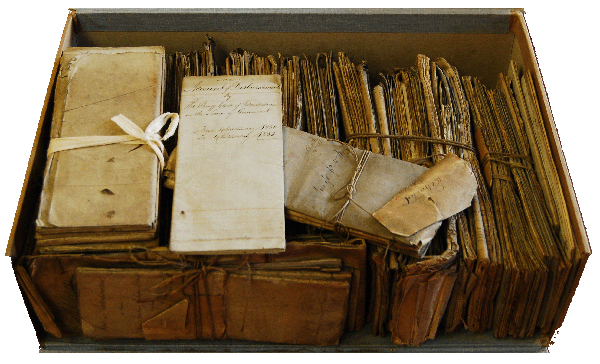
The problem is that the case was heard in Aberdeen. Unfortunately, the volumes of extracted decrees for Aberdeen Sheriff Court are largely missing (we have indexed the few remaining volumes which are held by the National Records of Scotland). The processes, a type of court document, do survive and they can contain very interesting information, we have even found love letters. The problem is that it can take hours of work to find the entry you need.


The NRS catalogue states about the Aberdeen Processes, “Some processes have been filed under dates other than year of Interlocutor (sometimes through misreading of the figures), but most will be found in the two years before or after that date.”


Our client decided she wanted to search for the 1857 processes. We began our search some months ago. As you can imagine, even in the 1850s, Aberdeen Sheriff Court was busy so there are a lot of boxes (you can see a photo of a box of processes on our website).


There are 10 boxes for 1857, to search 2 years either side (as is suggested in the NRS catalogue) would mean searching 55 boxes!


We have now searched 15 boxes, all the 1857 boxes and some either side. We have found 167 cases… but none of them are the case we are looking for.


The good news is that by making this search we have noted all these other cases so that you can now search these entries on www.scottishindexes.com. We want to say a huge thank you to the client who has helped us add these cases, and let you know that if you had an illegitimate ancestor in Aberdeen it may be worth searching our website to see what you can find. If you do find a case which helps with your research, take a moment to think about our lovely client who can’t find her case.


Monday, 1 May 2017

Register of Emigrants from the Western Isles to Ontario

Kisimul Castle, Castle Bay, Barra

Chris Lawson emailed to let us know about a new publication of special interest to people researching their family from Uist and Barra in the Western Isles of Scotland. We thought this was a great opportunity to share some of our photographs from Barra.

Barra is a breathtaking island and well worth the journey. The reality is that as beautiful as the island is, many people have left over the years. Bill Lawson Publications have just published a 'Register of Emigrants from the Western Isles to Ontario' Volume 2.

This volume covers the main area of emigration from North and South Uist and Barra to Ontario and gives details of over 300 emigrant families from these areas. This new volume is priced at £15 and is available from www.billlawson.com along with volume 1 which is priced at £12.


Monday, 10 April 2017

Scottish Roman Catholic Parish Records


You can now access Scottish Roman Catholic Parish Baptisms, Marriages and Burials on FindMyPast. These have been available on ScotlandsPeople for a while but for those of us with the British subscription package to FindMyPast these Catholic records will be included in our existing package.

If you’re researching on a budget it’s worth asking if FindMyPast or other sites are available through your local library. One library they are available in is the National Library of Scotland. Also FindMyPast offer a free trial so this could be a great time to start tracing your Scottish family tree.

If you’ve been researching your family tree but you’re a little stuck, come to us and we can help you get over the brick wall and get your research back on track.

Friday, 22 April 2016

Finding Historic Mental Health Records in Scotland

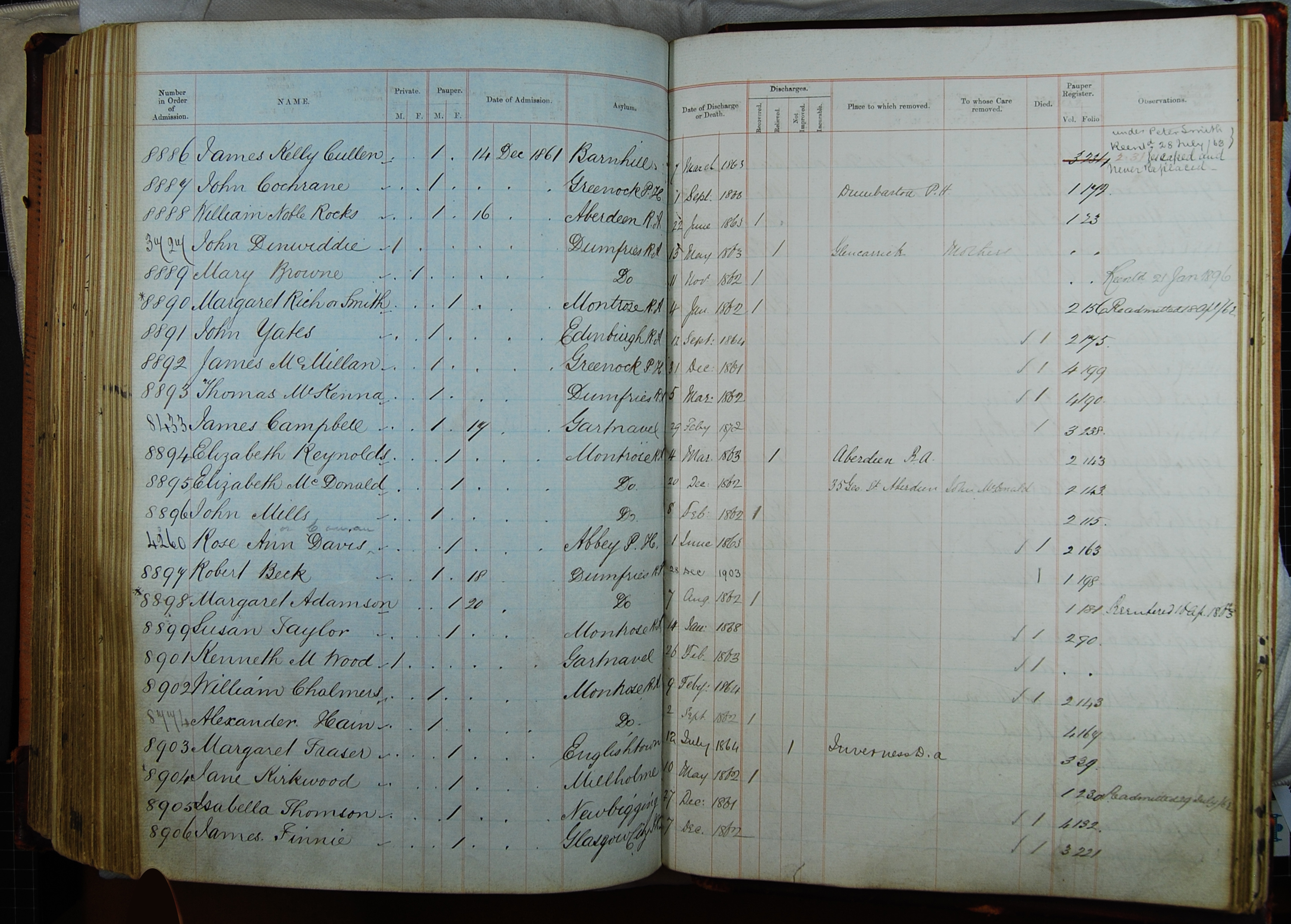
We have been working hard over the last few months to index historic mental health records in Scotland. We have just released thousands of new records and hope to add to this over the next few weeks. The work is supported by volunteers and sponsors!

‘General Register of Lunatics in Asylums’
We are indexing the ‘General Register of Lunatics in Asylums’. This register begins in 1858 and records all patients in mental health institutions (often referred to as lunatic asylums) in Scotland.

While we have been working to index the historic Mental Health records for Scotland, we have been researching them and trying to locate more surviving records along the way.

We have been working with archives across Scotland to collate all this information into one place. You will find a page for each ‘Lunatic Asylum’ which will tell you its alternative names, its location, if any indexes exist, where the records are kept and (for asylums in operation before 1857) a description of the asylum. We hope you will all find this useful.

To learn more about our ‘Mental Health Records in Scotland’, including seeing examples of the records that we are indexing, visit our Learning Zone.


Tuesday, 7 July 2015

7 July 1905 - Peebles Hydropathic Burned to the Ground

Peebles Hydropathic before the fire

To us researching your family tree is more than just gathering names, dates and places. Tracing your genealogy should be a journey of discovery, getting to know the people along the way, in effect having your own ‘Who Do You Think You Are?’ experience!

Edinburgh Evening News
08 July 1905
Copyright British Newspaper Archive
Newspapers and old photographs are a great way to add to the knowledge you have gleaned from certificates and census returns. Sometimes newspapers name our ancestors but at other times we will need to think a little more laterally, searching for stories about the places they lived and worked.

On this day 110 years ago the Peebles Hydropathic hotel was burned to the ground. As you can see from the photographs that accompany this blog the destruction was devastating and complete. For those visiting the Hydropathic, those staying there and those living in the town it must have been one of the most, if not the most, traumatic events in their lives.

Peebles Hydropathic after the fire
The newspaper accounts don’t mention many people but you may have found from the census that your ancestors worked at the Hydropathic, if they did they were likely involved in the incident. The lesson is to think laterally when searching the newspapers and you may discover an incident that would have impacted on your family greatly even though they are not mentioned as individuals.

The British Newspaper Archive is a wonderful resource if you are searching for UK ancestors. They are steadily increasing their holdings and you can also request certain newspapers. The BNA collection is also part of some Findmypast subscriptions. If you live in Scotland you can access many Scottish newspapers through the National Library of Scotland’s ‘Licensed digital collections’ (free): all you have to do is register. The NLS also has a large collection of newspapers on microfilm that are free to view in person.

Many local libraries and archives hold newspapers for the local area and libraries such as the Ewart in Dumfries allow digital photography. There are also many newspapers on Google which are free to use.

The New Peebles Hydropathic


Tuesday, 21 April 2015

The Kelso Dispensary


For the majority of people in 1777 there was no proper health care. Struggling to simply feed and clothe their children, most families couldn’t afford to see a doctor or buy medicine from the apothecary. This meant that of course there was high infant mortality, and countless families left to rely on the parish for poor relief when the man of the house was taken ill, or died.


In Kelso a group of men and women wanted to change this and they founded the Kelso Dispensary. A charitable institution, it was founded by benefactors and subscribers. Each subscriber could ‘recommend’ people who couldn't afford to see a doctor and they would receive free healthcare.


The records that the institution left behind are fascinating. They record who visited the dispensary, which parish they were from, who recommended them, the date seen, the age of the patient, the disease and the outcome of the case.


We think it is fitting that the records of this charitable organisation are the first to be indexed by our ‘Sponsor an Index’ programme. The first 1,743 entries are now online for you to access for free.

We hope that these prove useful to you. If they don’t cover the period needed get in touch about our ‘Sponsor an Index’ programme and together we can get more of these records online.

UPDATE 18 March 2016: The indexing of volume 1 is now completed. There are now 2,561 entries online! Search online for free: www.scottishindexes.com

Sunday, 19 April 2015

Sponsor an Index


The Problem!

Just a few short years ago there was very little in the way of online genealogy indexes. Tracing your ancestry was slow and time-consuming. Today the world has changed, and many people can trace their family tree in Scotland using online records, perhaps getting back as far as 1800 in just a few hours!

Sometimes, though, we hit a roadblock. We may also be intrigued about the lives of our ancestors and want to dig deeper.

Even if we know that records exist that could help us further, if there is no index and we are not fortunate enough to live near the archive where these records are held, it can be very expensive to have someone research our family tree for us. What we need is an online index!

Large companies are working on this situation by indexing a large number of records, then selling subscriptions. This can be useful if the company has a large number of records that you want, but can be frustrating if you sign up to find out they don’t have the records that will help you.

We want to provide a free website, one which gives you the source reference of the original document so that you can go and view the original record for free, or if you can’t visit in person pay just a small fee for the record you need.


The Solution

We are finding that more and more clients ask us to search records that could also be useful to other researchers. This has left us with the conclusion that it may make more sense for individuals to ‘sponsor’ an index. This way the genealogy community as a whole only pays once for the indexing to be done. The index goes online for free and then all your distant cousins can use it too.


How it works

You sponsor an indexer to spend a set amount of time (in 30 minute blocks) to index a record of your choice, with a date range of your choice. That set amount of time will be spent on indexing the record you have chosen, and then the index will be made freely available online for everybody to access. As a sponsor your name will accompany the release of the new index entries, and  will also remain permanently on our ‘Sponsor Appreciation Page’. Additionally, if the new index contains a specific entry you are looking for you will receive it free of charge.

We have a list of records ready and waiting to be indexed, but if you don’t see what you need get in touch and we’ll see if we can index the record you’re looking for.

30 minutes - £7
1 hour - £10
5 hours - £40

Most items held by the National Records of Scotland can be indexed, but there may be additional charges, get in touch and we’ll see what we can do. Search their catalogue to see what treasures they hold that we could help you access.


How much will be indexed?


How much can be indexed in a set period of time depends on the type of records involved. The ‘Notices of Admissions by the Superintendent of the Mental Institutions’ are one of the slowest records to index. A volume (one month) can take up to ten hours! Prison registers are among the quickest, with over 100 prisoner entries being possible in an hour. Once we know the record you are interested in, we can advise as to the amount we can likely index in the time available.


What to do next

Visit our ‘Sponsor an Index’ page on our website and choose how long you would like us to spend indexing the record of your choice. Add that time to the PayPal cart and proceed to the checkout. Once your payment is through I will email you and you can tell us what you would like us to index. You can find the list to pick from here.


Monday, 9 March 2015

Then and Now - The Photography Competition


We have an exciting competition which will be running throughout the spring and summer this year. We all love to revisit places we went as a child and see how much they have changed but also how much they have stayed the same.

If you have traced your family tree and visited the house your great-grandmother lived in you may have well felt quite emotional when you realised the step you were standing on was the one she would have washed 100 years ago.

The Scottish Indexes competition asks you to revisit these places and take a modern-day photograph which is based on an historical photograph. You can either use one of your own family photographs that was taken over 30 years ago, or choose one from our flickr archive (which is over 30 years old). The modern day photograph must have been taken this year and by you.

There will be five opportunities to submit a photograph, the closing dates will be the last days of the months of April, May, June, July and August. The winner each month will receive a genealogy ‘goody bag’. The prize will always include an hour of our research time as well as other genealogy gems to help you along your way.

How to enter:

Email your photographs to emma@scottishindexes.com

If your modern day photo is based on one of our flickr photos please tells us.

April submissions can be made from midnight GMT on 1st of April until midnight GMT on the 30th of April
May submissions can be made from midnight GMT on 1st of May until midnight GMT on the 31st of May
June submissions can be made from midnight GMT on 1st of June until midnight GMT on the 30th of June
July submissions can be made from midnight GMT on 1st of July until midnight GMT on the 31st of July
August submissions can be made from midnight GMT on 1st of August until midnight GMT on the 31st of August

Your modern day photograph does not have to be taken in the month you submit the photo.

How to win:

Photographs will be rated on accuracy, try to take the photo from the same place and angle that the original was taken. If you can’t because the photo was taken from somewhere inaccessible, such as private property, or somewhere unsafe, such as the middle of a road, let us know and we’ll take this into consideration. Keep yourself safe and don’t break any laws just to take a photo!

We’ll also be looking for a well exposed photograph, a higher quality photo is more likely to win.

We’re also looking for what I call ‘interestingness’, that is a photo that makes me go wow!

Finally, if you have a story to go with the photo, tell us. There is nothing like some tugging at the heartstrings to make make us give you some extra points.

Terms:

The photo must be taken in Scotland.

By submitting a photo to this competition you will be giving us permission to use your photos (old or new) on our Facebook page, our website etc. By entering the competition you will also be agreeing to us publishing your first name online as the winner of the competition.

You may enter up to 3 times over the course of the 5 months.