Showing posts with label ancestry. Show all posts

Tuesday, 12 January 2021

Tips for finding our ancestors in the 1911 census


As many of you will know the 1911 census for Scotland is not available on Findmypast or Ancestry. The Orkney 1911 census has been transcribed and is available from the Orkney FHS.

This means that we have to use the census on ScotlandsPeople which is a pay-per-view website. If we are researching a common name in a densely populated area we may have to look at many entries before we find the right one. 

How can we save those credits?

I will be sharing some tips at our conference on 30 January 2021 but here is one for you today.


Use Street Indexes

Before the census was available to public access, street indexes were prepared for large towns and cities. These can be helpful as they tell you which streets are in each registration district and even which census enumeration book. 

For example, earlier today I was searching for someone who I knew had been living at 272 Buchanan Street Glasgow in 1909. I wanted to work out from the ScotlandsPeople index (without paying anything) if any of the possible results could relate to 272 Buchanan Street.

First I went to the census street index for Glasgow and I was told that 272 Buchanan Street was in registration district number 644/8 and the relevant enumeration book was number 29.

Sadly you can’t use these reference numbers to search on ScotlandsPeople so I needed to work out what the name of registration district number 644/8 was in 1911. For rural areas, this isn’t such a problem but there are loads of districts in Glasgow, Edinburgh, Aberdeen and Dundee. It can all get a bit confusing. 

I now headed to the ‘Registration District guide - Glasgow’ which told me that in 1911 (very important to look at the date column) 644/8 was St. Rollox registration district.


I could now return to ScotlandsPeople and narrow down my search to St. Rollox. You can’t narrow it down to the enumeration book but we are looking for entries from 644/8 29. 


On ScotlandsPeople you will also see a page number as part of the reference number, for example we may see, ‘644/8 29/ 26’ This is registration district (RD) 644/8, enumeration book 29, page 26.


If I had originally thought that the entry with the reference 644/8 29/ 26 was 272 Buchanan Street, Glasgow, I would now know that it wasn’t and therefore I could save my credits for another search.


There are 1911 Census Street Indexes for the following places in Scotland:

Aberdeen

Ayr

Bonhill

Bothkennar, Grangemouth and Polmont

Bothwell, Holytown and Bellshill

Cambusnethan

Dalziel

Dumfries

Dunbarton

Dundee

Dunfermline

East and West Calder

Edinburgh

Falkirk

Glasgow

Greenock, Gourock and Port Glasgow

Hamilton

Hawick

Inverness

Kilmarnock

Kirkcaldy and Dysart

Lewis and Harris

Montrose

New Kilpatrick

New Monkland

Old Kilpatrick

Old Monkland - Western District, Coatbridge and Old Monkland - Eastern District

Paisley, Johnstone and Elderslie

Perth

Skye

St Ninians

Stirling

The Street Indexes are free from the National Records of Scotland here: https://www.nrscotland.gov.uk/research/guides/census-records/1911-census#Street%20indexes

The ‘Parishes and Registration Districts of Scotland by name’ guide (1.4 MB pdf) lists all parishes and districts in alphabetical order with the dates during which each was operative. There are also pages with further breakdowns of the cities of Aberdeen, Dundee, Edinburgh and Glasgow. See: https://www.nrscotland.gov.uk/research/guides/statutory-registers/registration-districts

I hope this helps you understand the referencing system a bit more and will hopefully save you some of those credits while you hunt for your ancestors. Hope you can join us at the next conference for more Scottish genealogy tips!


Friday, 2 February 2018

Free Scottish Genealogy Tutorials

We are creating free family history tutorials to help you trace your Scottish family tree.

Our first tutorial will show how to find your ancestors on historical maps, using our website.


Our second tutorial demonstrates how to use 'wildcards' to find those ancestors who never seem to spell their name the same way twice!


Subscribe to our YouTube channel so that you don't miss the next tutorial.

Wednesday, 12 April 2017

Scottish Adoption Records

The National Records of Scotland
One of our Frequently Asked Questions is: How can I locate adoption records? It comes as a surprise to many people that until 1930 there was no formal adoption process in Scotland. Formal adoption records are closed for 100 years but if you are the child concerned you can access your own records. See the National Records of Scotland’s website for details.

In most cases people ask us about adoption records because they have been researching their family tree and discovered that their ancestor was orphaned at a young age, raised by someone and record these ‘adoptive’ parents as their parents on a marriage certificate or other record.

In many cases the arrangements for an orphaned child were done on a private basis, perhaps the child was taken in by a relative, friend or neighbour. In some cases children were ‘boarded out’. These are usually cases where a child would have been in the poorhouse but rather the parish arranged for a local woman to care for young children, what we would call foster care today. Of course some children did end up in the poorhouse if there was nobody to care for them.

If this has happened to your ancestor, you may well want to find out more about the situation. Poor records are often the place to start. You can find a comprehensive list here, click the link ‘Records_of_the_Scottish_Poor.pdf’. This list, created by Scottish genealogist Kirsty Wilkinson will tell you which records exist and where to find them.

If you need any help get in touch and we’ll see how we can help you.

Friday, 19 February 2016

The Kirk Sessions - More than just fornication cases!

Canonbie Kirk as it is today
We often turn to the Kirk Sessions to look for cases of fornication when our ancestors were illegitimate. If it was discovered that a child was born to unmarried parents the couple would be brought before the Kirk Session, this was a group of men who would investigate ‘sins’ and discipline congregation members. The minutes of the Kirk Session are a wonderful resource when you are tracing your Scottish family tree and by far the most frequent cases are those of fornication but they are not the only ones you may come across.

While searching the records for a client today we found an entry in the Canonbie Kirk Session which is really very sad and quite different from the usual type of case. The entry has the National Records of Scotland reference CH2/1582/1/2:

1 August 1736
Canonbie Grave Yard 
“The session being informed that several people make graves in the church yard without acquainting the Beddel [Beadle] and sometimes encroach upon the property of others And John Armstrong having apprehended Gilbert Elliott in Broomiknow makeing a grave for a child of his complained to the Minester who ordered him to be summoned to the session which summons the session sustains and they resolve to rebuke him severely for his disorderly practice for a terror to others and if they do not desist to apply to Mr Lang chamberlane [likely Water Laing, chamberlain to the Duke of Buccleuch] to use his endeavours to prevent it But understanding that the said Gilbert is out of the countrey they order him to be summoned again to the session when he returns.”

Obviously you couldn’t have people going and digging up graveyards but it makes you wonder why the bereaved Gilbert Elliot had done it in the first place. Other than the fact that we learn that a daughter of Gilbert Elliot died (it doesn’t name the daughter) there is not a lot of genealogical information but it is interesting and it could help you understand your ancestors. So perhaps next time you are in the National Records of Scotland it may be worth looking at the Kirk Sessions even if you don’t have illegitimate ancestors!

Monday, 26 October 2015

Smallpox in the National Records of Scotland

Smallpox is a word that has inspired fear for generations. Our ancestors suffered with little help and it was not until the 26th of October 1977 that the world’s last naturally occurring case was discovered.


We are the product of generations of ancestors who survived long enough to have children, but we know that sadly many of our ancestors’ siblings did not survive. It is rare to find detailed health records of our ancestors, so although we might theorise that they endured diseases such as smallpox we do not often have any evidence one way or the other.


Clues do exist, though, if you know where to look. One interesting source is the prison registers held by the National Records of Scotland. Victorian prison records are very detailed, and one of the columns on the registers was headed ‘Marks’. In this column, as well as finding details of tattoos or scars, we commonly see written ‘pock marked’, ‘poxpitted’, ‘pock pitted’ and even ‘Marked with small pox’. A person could become pockmarked by various skin conditions, but smallpox was a major cause of such scarring. Depending on the description used, it can be very clear that they suffered from smallpox at some point in their life, information which may not be found in any other record. The image to the left shows William Phillips and Betsy Phillips are recorded as being marked with the smallpox in an 1848 prison register; you can search an index to these records on our website.


Another source of information is the Kelso Dispensary patient records, which are also held by the National Records of Scotland. These records provide a fascinating glimpse into the history of smallpox. Founded in 1777, this charitable institution saw patients with many ailments, and smallpox is frequently seen in the records. Between October 1793 and October 1794 the Dispensary saw 29 cases of smallpox, with one case resulting in death.

Click to see image full size

The records of the Kelso Dispensary document many cases of smallpox. Above we see an entry for Thomas Tenant who died of the disease in 1797. This entry is again from the National Records of Scotland, their reference number for the document is HH71/43.

In 1796 a physician named Edward Jenner discovered that infecting someone with cowpox gave them protection from the much more dangerous smallpox. This was effective because when a person was exposed to cowpox, the human body produced antibodies which helped protect them from smallpox. This was the world’s first vaccine!

The vaccine came too late for poor Thomas, though. Just a few years later, on 10 August 1800, we see the first entry of smallpox inoculation by the Kelso Dispensary. Sadly the names of the children are not listed but these ten children surely have a place in history.

Click to see image full size

As with many new ideas the smallpox inoculation (or vaccination) was not universally accepted. Cartoons of the time depict the fear that the public had at the time, that somehow the cowpox may turn them into a cow! Science prevailed however and the results were clear. In time an improved vaccine was made and the rest, as they say, is history. This terrifying disease now only exists in laboratories, let’s hope it stays that way!

When researching our ancestor’s past we are not content with a lists of names, dates and places, we want to dig deeper and understand the people we are descended from. By looking at a variety of records you can do that too. We are working on a project to index Scottish prison and health records so that you can trace your family tree and find out more about the people behind the names, including the diseases they had to endure. Search www.scottishindexes.com for the names of your ancestors and discover more about their lives.

A page from a prison register

Tuesday, 7 July 2015

7 July 1905 - Peebles Hydropathic Burned to the Ground

Peebles Hydropathic before the fire

To us researching your family tree is more than just gathering names, dates and places. Tracing your genealogy should be a journey of discovery, getting to know the people along the way, in effect having your own ‘Who Do You Think You Are?’ experience!

Edinburgh Evening News
08 July 1905
Copyright British Newspaper Archive
Newspapers and old photographs are a great way to add to the knowledge you have gleaned from certificates and census returns. Sometimes newspapers name our ancestors but at other times we will need to think a little more laterally, searching for stories about the places they lived and worked.

On this day 110 years ago the Peebles Hydropathic hotel was burned to the ground. As you can see from the photographs that accompany this blog the destruction was devastating and complete. For those visiting the Hydropathic, those staying there and those living in the town it must have been one of the most, if not the most, traumatic events in their lives.

Peebles Hydropathic after the fire
The newspaper accounts don’t mention many people but you may have found from the census that your ancestors worked at the Hydropathic, if they did they were likely involved in the incident. The lesson is to think laterally when searching the newspapers and you may discover an incident that would have impacted on your family greatly even though they are not mentioned as individuals.

The British Newspaper Archive is a wonderful resource if you are searching for UK ancestors. They are steadily increasing their holdings and you can also request certain newspapers. The BNA collection is also part of some Findmypast subscriptions. If you live in Scotland you can access many Scottish newspapers through the National Library of Scotland’s ‘Licensed digital collections’ (free): all you have to do is register. The NLS also has a large collection of newspapers on microfilm that are free to view in person.

Many local libraries and archives hold newspapers for the local area and libraries such as the Ewart in Dumfries allow digital photography. There are also many newspapers on Google which are free to use.

The New Peebles Hydropathic


Saturday, 28 March 2015

‘Then & Now’ Competition - April Prizes Confirmed

We are delighted to be able to confirm the prize for the April ‘Then & Now’ photography meets genealogy competition.


The winner will receive:

A current issue of Who Do You Think You Are? magazine
The Who Do You Think You Are? magazine’s Essential Guide to Family History
A family tree wall chart
A map showing WWI battle fronts
A handy credit card size magnifier
A Scotland's People eraser
Research guide leaflets
An hour professional genealogy research.


All these items will be posted to you free of charge. The genealogy research can be swapped for five transcriptions from our website www.scottishindexes.com.

The closing date for April is 30th April 2015.


For details of how to enter see our blog post: Then and Now - The Photography Competition.


Details of prizes you can win in other months will be posted once they have been confirmed.


Wednesday, 24 September 2014

No Books Were Harmed in the Making of this Index

Day after day people visit archives around the world and look at historic paper records. Sadly each time these items are handled they deteriorate. There is no point, though, in keeping records if nobody can ever access them!


Letter found in Sheriff Court records.
NRS reference number SC62/10/390 Heatlie V Bell 
Back in 1911, when access was requested to the Old Parish Registers of Scotland (OPRs), the then Registrar-General (James Patten McDougall) said “...I am afraid it would open a very wide door and might lead to abuses, e.g. the public would come here without having recourse to the ordinary registers, and their object in coming might be prompted by mere inquisitiveness. Further I am afraid that these old books would not last long if handled by all and sundry.”


I wonder what poor James would make of Scotland’s People? Perhaps he would be delighted as it means that we do not have to handle the original volumes any more. While we might find his words amusing, we also must acknowledge the point: the more often books are handled the more quickly they will wear out!


Whilst the OPRs, census returns, valuation rolls, birth, marriage and death records have now been digitised this is a drop in the ocean of what exists in the National Records of Scotland.


Mental Health Records.
NRS reference number MC7/1

The documents Graham and I are indexing for scottishindexes.com have not been digitised, meaning that we are making use of the original records. As such, we have a responsibility to look after the records we access and avoid damaging them for future generations.


On occasion, we find that cannot read a record in entirety, often because a volume has been bound tightly and some of what is written is obscured by the binding.


When this happens, it may mean that a record, or index entry cannot be completed. In such cases, we insert in square brackets what we believe will complete the record, or indicate that something is missing.

When searching scottishindexes.com and you see square brackets you’ll now know what they mean, and you can rest assured that no books were harmed in the making of the index!

Tuesday, 19 August 2014

#DGHour hints and tips for Ancestral Tourism in Dumfries and Galloway

According to Tourism Intelligence, ‘10 million people with Scottish roots are interested in finding out more about their ancestry. It is estimated that 4.3 million people could be encouraged to visit.’

This blog post has been specifically created following the #DGHour we had on Twitter in August 2014 and is designed to help those in the tourism industry help people trace their family tree. I hope however that it will also help individuals tracing their Scottish family tree.


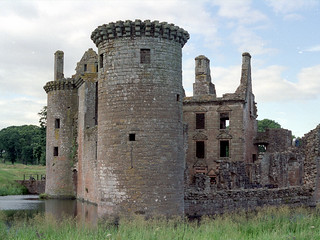
Caerlaverock Castle

Heritage Tourism or Ancestral Tourism

One thing to mention at the outset is that there is a difference between what we might call ‘heritage tourism’’ and ‘ancestral tourism’’. As an example, some people with the Maxwell surname may choose to visit Caerlaverock Castle, because (I quote from the Historic Scotland website) ‘around 1220, Alexander II of Scotland, needing trusted men to secure the Scottish West March, granted the estate to his chamberlain, Sir John de Maccuswell (Maxwell). Sir John built the ‘old’ castle. Within 50 years, his nephew, Sir Herbert, had moved to a new castle just 200m away to the north. There the Maxwell lords remained for the next 400 years.’ The reality is however, that many people with the Maxwell surname are not directly descended from these Maxwells.

One dictionary definition of genealogy is ‘A line of descent traced continuously from an ancestor’.

Your first mission, therefore, is to find out what type of experience your visitors want. Do they want to visit a castle once owned by someone of the same surname, or do they want to trace their own direct ancestors one by one as far back as they can?

If they want to trace their own genealogy, here are some resources and tips so that you can be better placed to help them:


Accommodation - What to offer the Ancestral Tourist

A good internet connection - A lot of family history research is done online these days. Many people will have their family tree online on websites like ancestry.com. This means a good internet connection is essential to family history research. If you can offer this as part as your accommodation package the ancestral tourist will likely find your accommodation a more appealing choice.


Reference books - For south west Scotland, I would recommend the guide produced by the Dumfries and Galloway Council, ‘Researching Local History - A Guide’ (available at £5.99 from most D&G libraries). I would also recommend the book ‘Tracing your Scottish Ancestors’ published by the National Records of Scotland. Other books such as ‘The Surnames of Scotland: Their Origin, Meaning and History’ by George Black may also be useful to visitors. If you want to have an even larger library for your visitors I would also recommend the books by Chris Paton.

Visit Scotland’s Ancestral Welcome Scheme - Participation in the Ancestral Welcome Scheme gives you the opportunity to publicise your knowledge and commitment to meeting the needs of the ancestral visitor. For more details see the Visit Scotland website.

Scotland’s People - www.scotlandspeople.gov.uk is the foremost website used in researching Scottish Ancestors online. They give access to the key building blocks of a family tree: Birth, Marriage, Death, Census and Parish Records as well as wills and some other key resources. The website is a ‘pay-per-view’ site (not a subscription website). Scottish libraries sell half price starter cards, giving 60 credits which can be used on the site for just £7 (the standard price is 30 credits for £7).


Once your visitors arrive

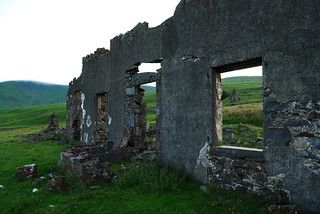
The Old School House at the long abandoned Woodhead lead mines, Carsphairn, Stewartry of Kirkcudbright.

Maps - People visit the area where their ancestors lived is to visit the homes they once occupied and visit their graves. If you are able to offer help by supplying maps this would really help your visitors. The National Library of Scotland has a fantastic collection of historic maps (many of which can be overlaid on modern maps for comparison) which could help them work out where a long demolished house once stood.

Archives - At the time of writing (August 2014) the main archive for Dumfries and Galloway is within the Ewart Library (Catherine Street, Dumfries, DG1 1JB). Access is free and you can use your digital camera to photograph many records (permission needed). Here are the opening times:

Archive Search Room Opening Times
Monday- CLOSED
Tuesday - 10.00 - 13.00, 14.00 - 17.00
Wednesday - 10.00 - 13.00, 14.00 - 19.00
Thursday - 10.00 - 13.00, 14.00 - 17.00
Friday - 10.00 - 13.00, 14.00 - 17.00
Saturday - 10.00 - 13.00, 14.00 - 16.00 (First Saturday in month only)

Important - Most archive material is stored off-site, you need to contact the archive a day or two in advance so that they can make sure the items you need are brought in for you.

The archive at Dumfries has records such as school log books, poor relief applications and minutes, valuation rolls and newspapers throughout D&G. They also have copies of the census for D&G on microfilm and also local pre-1855 parish records (OPRs). As well as providing access to these key resources they also have a genealogist who can help searchers; there is a fee for this service and booking is essential.

Dumfries Archive in the Ewart Library

Other archives and museums - Whilst the Ewart Library is the main repository, local museums and libraries throughout D&G can also be useful. They sometimes have original records, and in many cases have key resources in the form of printed transcripts and microform. Most importantly, though, they can provide local knowledge!  This map can help you find archives across Scotland. The guide book published by D&G council that I have already mentioned (Researching Local History - A Guide) includes a comprehensive list with contact details.

Online Indexes

Friends of the Archives of Dumfries and Galloway - A lot of work has been done by the Friends of the Archives of Dumfries and Galloway group to index historical records. These indexes include the 1851 Census, Dumfries Jail books, various Kirk Session Minutes, Poor Board Minutes and much more. All indexes are free to access from the archive’s website.


Scottish Indexes - Our own website www.scottishindexes.com has census indexes, prison indexes, patenity indexes, mental health indexes, as well as birth, marriage and death indexes.

Gravestones - The website www.kirkyards.co.uk has free online access to gravestones or Monumental Inscriptions for a number of churchyards in the Stewartry of Kirkcudbright. Its sister site www.kirkcudbright.co has an historical index of the people and places of the Stewartry of Kirkcubright and other useful local resources.


Family History Societies and Researchers

Dumfries and Galloway Family History Society - The society is run by volunteers and has its premises in Glasgow Street, Dumfries. The opening times vary between summer and winter so it’s best to look at their website for details. As well as being able to visit the research centre and use their resources you can also buy their publications.

Dumfriesshire and Galloway Natural History and Antiquarian Society - This society is perhaps more immediately thought of by the historian than the genealogist but as they are so closely connected I have included them in this list. Their website has an index to their transactions and many volumes are online.

Scottish Indexes - Most people these days are able to trace their own family tree, sometimes however they need some help. As well as providing indexes we also have a research service. Feel free however to give us a quick ring if you have people coming to stay and you need some advice on how to help them.

Scottish Genealogy Network - This is a group of professional genealogists working across Scotland. For more information see their blog.

If you have any questions please post a comment below and I’ll do my best to answer it.

Wednesday, 30 July 2014

Looking back to the beginning

This week’s throwback Thursday blog post is a little more personal, taking us back to the very beginning of Maxwell Ancestry. Even while we look forward to the future with Scottish Indexes (www.scottishindexes.co.uk launching tomorrow!) it’s nice to look back at where we came from.

Our founder Graham Maxwell’s family are a long-lived bunch, and it was spending time with elderly relatives which first piqued his interest in genealogy. He remembers hours spent doing jigsaws with his great grandmother when he was just a small child. Sadly, his great granny Maxwell died aged 85 when Graham was only four years old. On the other side of the family, however, his Great Aunt Mary lived until she was 104. Her memories provided a vital and fascinating resource when Graham began his family history research in earnest.

Mary Cameron aged 99, taken on 17 Feb 1989

In 1989, Graham and his mum made their first visit to the General Register Office in Edinburgh. Armed with the knowledge they had gained from family stories, their mission was to trace the family through birth, marriage, death and census records. They hoped this way to compile a coherent picture of their family history.


The records system took some getting used to, and the process of research was a good deal more time consuming than it is today. However, their efforts were rewarded - together they successfully traced their family tree before going on to write a family history book as a gift for Graham’s Nana and Pappa. Long before ‘Who Do You Think You Are?’ or Ancestry.com, Graham and his mum created an easy-to-read family history chronicle filled with family photos and historic postcards of places and people. Fascinated by the past, Graham has always endeavoured to understand the lives of people’s ancestors beyond mere names and dates. In this first family album he added a piece of linen woven in the mill where his ancestors once lived.                                             

                                                                 
Researching his own family history whetted Graham’s appetite for genealogy. When friends asked him to research their family trees he didn’t hesitate. His time delving into the records came with the growing realisation that he could translate his passion into a career, and he began to take on clients in 1996.

Over time the business grew, most clients hearing of the business through word of mouth. Graham continued to develop his skills and gained further experience as a genealogist, becoming a regular fixture in both the General Register Office (now the ScotlandsPeople centre) and the National Archives.


A lot has changed since these early beginnings – both for the business itself and within the field of genealogy. Maxwell Ancestry was amongst the earliest of ancestral research businesses to harness the power of the internet, allowing people from Manitoba to Melbourne to seek records. His wife Emma joined the business in 2001 and together the pair have helped people with research projects large and small. While we’re looking forward to launching our new site, our focus will remain on helping our clients – so they can have the ‘Who Do You Think You Are?’ experience Graham’s grandparents had all those years ago.

Graham Maxwell aged 20