Tuesday, 24 September 2013

Dumfries archive's new home in the Ewart Library - user guide.

I was in Dumfries on Friday, using the new archive section of the Ewart Library. It's looking very nice!


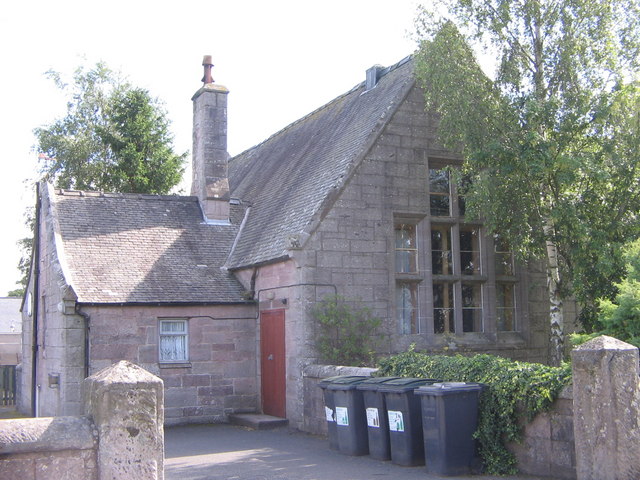
As you can see from the photo above they were still setting up on Friday but it's all starting to come together. There is now a door dividing the archive and local studies area from the lending section of the library and within this section there is another room for consulting documents. This creates a very quiet area to concentrate but still close to the reference material on the open shelf. All in all it seems to be a very well designed space.

Ordering documents

It is obvious however that this is the best of a bad situation and not the ideal you (or they) would wish for. Before the move you consulted some material at the Ewart and some at the Archive Centre across town so having just one search room is easier. On-site storage is now very limited, however, as a lot of their holdings are now stored off-site. The recent move means that checking that the documents you wish to consult will be available on the day of your visit is vital, as the catalogue is not clear as to where the documents are stored. Our advice: always contact the archive first to make sure the documents will be available for consultation. They try to get them in very quickly but it is best to give them a few days notice if you possibly can.

Access

Parking is free for two hours on the street outside and I found there were a number of spaces near the door. Dumfries operates a parking disc system: if you don't have one you can get one form the library staff (they are free). There are also a number of disabled spaces outside the library. Being within easy walking distance form the train station too adds to the ease of access of this archive.

Photography

As with most forward-thinking archives in the UK, photography is allowed for your own personal use. There are restrictions on some items though so always ask for permission first. 

Research

If you need some research, but it's too far away for you to visit yourself get in touch with us and we can arrange to carry out the research for you: info@maxwellancestry.com 


Monday, 16 September 2013

Dumfries prison register

We have begun indexing the prison registers for Dumfries. As each year is indexed we will make it available on our website. We have 1841 and 1842 online so far and hope to add 1843 today or tomorrow.


The Dumfries register has some interesting characteristics. For example the description is a lot more ‘human’ than that which we have seen in other prison registers. In many prisons the description/marks column is left blank unless the individual had a tattoo, obvious scar or something similar. In Dumfries however it seems to have almost always have been filled in (for the years we have inspected so far) and gives such descriptions as “common”, “squints”, “stout”, “pock pitted”, “nearly blind in right eye” and even “white spots on his head”! Certainly a way to really learn more about your ancestors… if you dare!


The online index is free and we charge just £5 for a full transcription: Come and search today!


www.maxwellancestry.com/prison


Monday, 2 September 2013

Sheriff Court records

If you have been doing genealogy for more than five minutes you will have discovered that our Victorian ancestors were not quite as well behaved as we may have have been led to believe. The number of children born outside marriage, or within weeks of the marriage astounded me when I began researching.

This can present a real challenge to the family historian. In Scotland a marriage certificate after 1855 will sometimes give both parents’ names even in a case of illegitimacy. Sometimes, though, even with a name of the father, finding him can be more than a little challenging, as so little information is given about him. This can lead to the inevitable brick wall.

There are various ways to overcome this, one being the Kirk Session records of the Church of Scotland and other Presbyterian churches. These were well explained in the episode of ‘Who Do You Think You Are?’ featuring Annie Lennox. These are certainly a very sensible first port of call.

As the nineteenth century progressed, the Kirk Session records tend to decline in usefulness as fewer people are recorded in them, especially in the larger towns. This also means a record of baptism naming both parents is unlikely.

There is however another, often overlooked, source available and that is the Sheriff Court records. The Sheriff Courts deal with criminal and civil cases, and in looking for paternity cases we generally begin with the records of civil cases. A good place to begin is the decree books, where these exist. These are usually neatly written volumes, covering at most a few years at a time. The decree records the outcome of the case and will be helpful in giving us a brief summary of the facts as established by the court. The disadvantage has been is that these records are often time-consuming to search. The National Records of Scotland (NRS) hold them, but as they are not stored in the same building as the search room they must be ordered in advance a day or two before your visit. All of this is could seem quite a hassle and you have no guarantee of finding anything.

That is why I am so pleased to tell you that we have uploaded a new set of records to our website: Paternity Cases in the Decree Books of Jedburgh Sheriff Court. Our index to these records has been produced with the kind assistance of Margaret Hamilton. The books have been searched for paternity cases where the mother of an illegitimate child is taking the father (or his relatives) to court to receive aliment for the child.

You can search our court records page by mother or father and see if there is a case relating to your ancestors:

www.maxwellancestry.com


You can search by mother’s name alone, or by father’s name alone to see if your ancestor is in the database. You can also search by year to narrow down the results. Once we expand the database I will prepare some ‘how to’ guides. Follow me on Twitter to keep up-to-date @maxwellancestry


Tuesday, 27 August 2013

Decreet, Armstrong v Kirk - 2 September 1847

“Decreet, Armstrong v Kirk - 2 September 1847”, sounds innocuous enough, you may think. Not far into this particular decree, though, we find out some very useful genealogical information. The following decree is taken from a so far unindexed volume of the Jedburgh Sheriff Court Register of Decreets (or Decrees). Much of the material in these volumes concerns the resolution of financial disputes and the like. Interesting perhaps, but not as useful to the genealogist as the paternity cases interspersed amongst the courts business.

After 1855 we generally know if there was a paternity decree as it would normally be recorded on the civil registration birth certificate. Before 1855, however there may be very little information. Sometimes we can find an entry in Kirk Session minutes, but these have not always survived, and not all families were members of the Church of Scotland or one of the other leading Presbyterian churches which kept such records. Even when such minutes survive, the entries may give only very limited information regarding the parents.

Sometimes we see an illegitimate child use a father’s surname (often this is the case in the early census returns), and we may speculate as to the identity of the father. Sheriff Court decrees like the one shown in the extract below can enable us to positively identify the father of an illegitimate child and therefore overcome a brick wall in our family tree. The decree is often only the starting point, as in many cases the processes also survive. The processes are court papers which often give us much more information than the decree and help us to see the case from the perspective of both the pursuer and the defender.

I am pleased to say work has now begun on indexing these wonderful records. Watch this space!

In the margin we read:
Decreet
Armstrong
v
Kirk
2d September 1847

The body of the text reads as follows:

At Jedburgh the Twenty eighth day of July and the Sixteenth day of August Eighteen hundred and forty seven years Sitting in Judgment John Craigie Esquire Sheriff Substitute of the County of Roxburgh in an action raised before the Sheriff Court of the said County at the instance of Jemima Armstrong Daughter of and residing with William Armstrong Blacksmith in Morebattle Pursuer against William Kirk Blacksmith in Morebattle defender. The Sheriff Decerned and Ordained and herby Decerns and Ordains that the said William Kirk Defender to make payment to the said Jemima Armstrong Pursuer of the sum of One pound of inlying expenses of a male bastard child of which the pursuer was delivered on the twentieth day of March eighteen hundred and forty seven of which the said William Kirk is the father. Item of the sum of one pound ten shilling per quarter for three quarters of nursing fee. Item of Four pounds per annum of aliment thereafter payable quarterly and per advance which aliment is to continue until the said child shall arrive at the age of ten years unless the said defender shall when the child shall attain the age of seven years offer to take it to his own home and provide suitably for it reserving to the said child its relations to apply and shew cause for a continuance of the aliment after it shall arrive at the age of ten years and to the Defender his Defences as accords. Item of Interest on the several sums as they have become or may become respectively due until paid. Item of the sum of Three pounds & eight pence of Expenses of process and Item of the sum of four shillings as the dues of Extracting this Decreet and of Recording the same. And I the said Sheriff &c
Written by Geo. Henderson Collated by I Stewart Newbigging

Taken from Jedburgh Sheriff Court, Register of Decrees (NRS reference SC62/7/9, pages 4 and 5).

This record now helps us to identify the William Kirk or Anderson seen here in the census of 1851 as the child of William Kirk seen here. Hopefully unravelling a little mystery for the Armstrong family!

Do you have this type of mystery? I hope the indexes that we are going to make available soon will help. In the meantime email me with your genealogical queries and we will see what we can do.

www.maxwellancestry.com

Sunday, 25 August 2013

Grand Local & Family History Fair: Celebrating Lanarkshire 2013

We had a stall at the Grand Local & Family History Fair: Celebrating Lanarkshire 2013 yesterday, hosted by the Lanarkshire Family History Society. It was a marvellous event, well organised, well attended and full of interesting stalls.

Giving DNA advice for family history

As usual we were spending the day helping people unlock their family secrets. Graham helped a number of individuals through the free 30-minute genealogy consultations. Using his experience he managed to help a number of people overcome a brick wall so that they could continue their research.

We also encouraged a number of people to enter the world of prison records. Our free online index can unlock a part of your family's history hidden for over a century! The register itself tells you basic details such as name, address, age, place of birth and religion but also tells you details you are unlikely to find on any other record such as height, appearance, hair colour, eye colour, education and of course offence.

Whilst interesting in itself the prison register gives the date of a trial (if there was one) which means you can then go to the relevant court papers and find out more details about the offence and the people involved. Quite regularly the court documents will name family members or give some other clue to assist your research as well as offering a fascinating glimpse into the life of your ancestor.

All dressed up

With a huge array of stallholders there was definitely something for everybody at this event. I hope this becomes an annual occurrence!

Scottish Monumental Inscriptions

After the fair was over the members of the Scottish Genealogy Network met for our monthly meeting. It was great meeting some for the first time and putting a face to the name. If you are looking for a professional genealogist look out for the Scottish Genealogy Network logo on their website or blog!


Scottish Genealogy Network


Monday, 8 April 2013

Guest blog by Sarah Wendolyn Cheryl Miller, Ottawa, Ontario, Canada


Who is Mary Hyslop?


Spring-cleaning seems to last all year for me so whenever I can find a distraction, well there I go. As it happened, I was clearing out my bookshelves when an obituary of one my paternal great grandmothers fell to the floor. That started my genealogical journey. Soon I came across a name on a death certificate that seemed familiar.


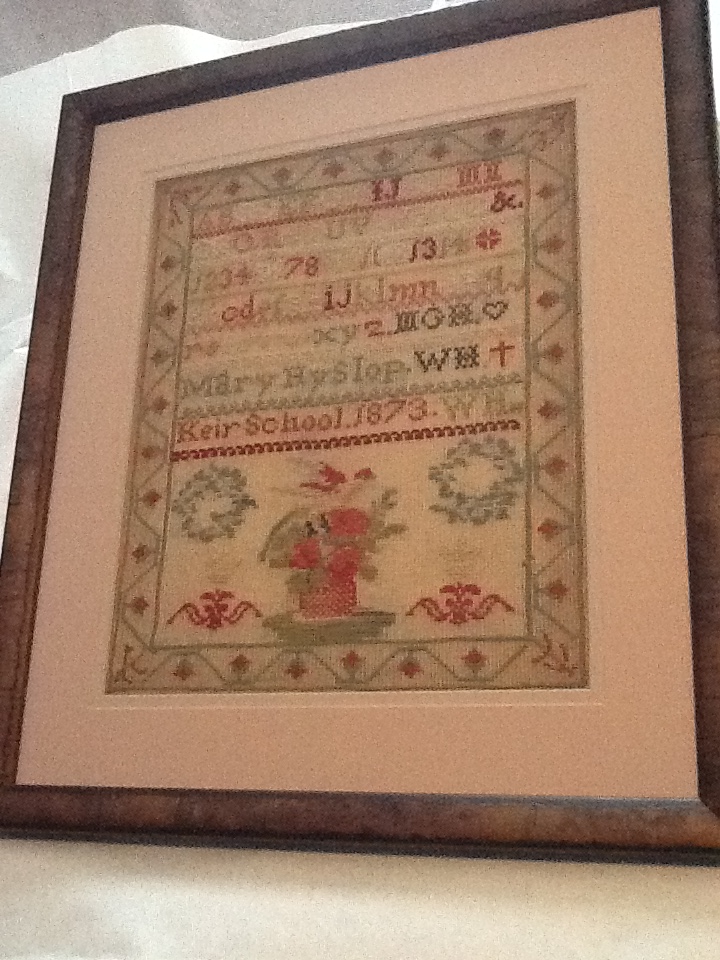
Then came the “aha” moment when one makes a find! Oh! I know that name! I know it! I quickly went and found a sampler that I had carried with me for years, stuffed in an old humpback trunk until, one day I had it framed to protect what I knew was history of some sort. I was troubled for years as to why I had this sampler. Who was this Mary Hyslop? Why do I have this? What was happening in 1873 when she so carefully crafted this piece of work, homage, I later learned, to her parents who had both died by the time she was 14 years old? Was I ever told this story or had I simply forgotten it?


My great grandmother, Mary Hyslop Barrowman Miller became a fixation for me. I wanted to know more about her and my Scottish roots. Childhood memories that linked me to Scotland swirled in my head: remembering blood pudding, big bowls of oatmeal porridge, my brothers and I badly chanting “If you can say it’s a brae bricht moon lich nicht, you’re all right, you’re kin”, Dundee marmalade, trips to the Highland games, my Black Watch Tartan skirt and vest all added to my new found sense of identity.

However, it was my great grandmother’s story that enthralled. Mary, born in England to Scottish parents (William Hyslop and Mary Barclay) lost her mother when she was only 3 years old. She and her younger brother William were sent to Scotland to be raised by Hyslop family members in Keir, Dumfriesshire (her Aunt Margaret Hyslop Halliday and her brother, their Uncle John Hyslop). Her father stayed in Stoke upon Trent, remarried and raised another family.

The sampler revealed some of this story and led me to many discoveries. I was aided in my quest by the kindness of unknown genealogical soldiers who loved mysteries and were keen to help. Through the good graces of one particular friend, now an honorary Hyslop, I began to piece together her story.

Old school Keir Mill © Copyright Derek Menzies

It is an ordinary life in many ways, Mary’s, but to me she is a wonder of strength and determination. She lived in Farthingbank Dumfriesshire (on the Buccleuh Estate, the lands of Drumlanrig Castle) when at 19 she married Alexander Barrowman, Master Flesher. He was from Armadale, where they lived and work. She lost her first child when he was just 1 year old to diarrhea from teething (who could imagine such a loss today
in Canada!). She and Alexander had another son, Robert Barrowman. After losing her first husband to tuberculosis, Mary probably worked as a Flesher and moved from over the shop in Armadale to Glasgow where she married her second husband, Robert Weir Miller. I am struck by her having a profession - “Flesher” – ghastly name for butcher but I hoped that she was really working in the storefront in Armadale and making sausage and pie, not slaughtering, as was likely the case. Both of her husbands were Master
Fleshers so it is likely they owned a business. I hope so. I would rather she not have to have done such hard work.

Mary’s fortunes held until her second husband died of pleurisy when she was just 33. She was living on Greenhill Rd. in Rutherglen at the time. Aha! My link to Glasgow was further explained.

There are many holes in between. In 1901, now widowed she lived in Rutherglen in a tenement house and worked as a dressmaker. Eventually, in 1907, Mary came to Canada, as did both of her two sons. Some of the history is missing but Robert Barrowman went on to become a very prominent citizen, holding the post of Mayor of Lethbridge for some time. He was an accomplished businessman but had an artistic side and painted landscapes. I have been in contact with his great grandchildren and shared Mary’s story
with them.

In Canada, Mary lived with her son James who went on to marry Maude Ellen Tuttle, my paternal grandmother. I believe Mary ran (owned?) a boarding house and soon the Millers and Tuttles combined accommodation at 212 Slater Street, Ottawa, Ontario. James was a soldier and enlisted in the Canadian Overseas Expeditionary Forces in the First World War but it is unlikely that he served overseas. I have looked at his service file (dusty papers almost 100 years old!) and seen that he was discharged on  ompassionate grounds. He died when my father was only 7 years old. Mary never got to see her grandson as she died the year before he was born. She is buried in Ottawa, at Beechwood Cemetery with her son James Halliday Miller.

In 2012, I journeyed to Scotland to see my adopted family in Falkirk, my genealogy angel, Margaret. What a thrilling time. I visited the Dumfries area where my ancestors lived, even driving into the bush that was called High Farthingbank. So much to take in, so much excitement I need to redo the journey now that I have a better understanding of the linkages to the larger Hyslop community. I need to find out more about the Miller side of the family too.

My newest discovery is a Hyslop contact in Dumfries who has a keen knack for uncovering family history and we are sharing our finds. We are not of the same Hyslop line....yet! She has been wonderfully helpful, not to mention a delight to get to know. She has helped me make a family link in Australia. Now I really need a direct family link in Scotland! The Hyslops are many.

My family line goes back to James Hyslop and Jane Moffat on one side and to Robert Hyslop and Mary Hastie on another. I am fairly confident of the links back to my third great grandfather, Robert Hyslop (b. 1791/1794 in Farthingbank and died in 1857 in Durrisdeer) and his wife, Mary Hyslop (b. 1794 Durrisdeer).

I have googled the name Hyslop in the Dumfries area and there are many. It would be so exciting to find a family link there now. Could I actually find photos of my relatives and ancestors? Would one exist of my dear Mary?

Mary is buried here in Canada near her sister in law Mary Jane (Muirhead) Hyslop, her brother William’s wife. I know little of his time here in Canada but think he did not have children and returned to Scotland sometime after his wife and sister had died. He died in 1929, in the Parish of Morton, Dumfries.

I had the sampler reframed – museum quality – safely protected behind glass that will not allow light damage and with acid free matting. It is beautiful. See for yourself.


Great granddaughter of Mary Hyslop (1859 – 1916) - “She was born to serve mankind”….hmmmm why was that on her headstone?


Free 30 minute genealogy consultations


We are offering free 30 minute genealogy consultations at the 24th Annual Conference of the Scottish Association of Family History Societies to be held at the Scottish Borders Campus, Nether Road, Galashiels, TD1 3HE, Scotland from 10am to 4pm on Saturday 11th May, 2013.

The idea is to help you get over an obstacle, perhaps by directing you to a type of record you haven't used before, or by accessing our vast library to overcome your problem. To enable us to help you, email us as soon as possible to book your time slot and tell us all you know about the family. That way we can have a look over your family before the event.

There are limited slots available, here is what we have left:


Click the link above to email me, tell me the time you would like and tell me as much as possible about your family.

For more information about the family history fair visit the website of the Borders Family History Society

www.maxwellancestry.com