Saturday, 3 February 2018

Was Your Ancestor a Convict?


Every year the Scottish Association of Family History Societies (SAFHS) hold a conference and family history fair. This year the theme is, "Was Your Ancestor a Fife Convict?"

The annual event will take place this year on 21 April 2018 at the Rothes Halls, Glenrothes, Fife. 

One of our genealogists, Emma Maxwell, will be giving the talk, “Finding Your Ancestors' Footprints” and all the talks will revolve around the theme of criminal records. 

As well as the four talks there will be a free ‘Ask the Expert’ area, hosted by the Scottish Genealogy Network. It will be a great opportunity to get some professional advice on how to trace your family history.

To find out more and book your ticket go to the SAFHS 2018 website

If you need help to find out what life in Scotland was like for your ancestors get in touch and see how we can help.


Friday, 2 February 2018

Free Scottish Genealogy Tutorials

We are creating free family history tutorials to help you trace your Scottish family tree.

Our first tutorial will show how to find your ancestors on historical maps, using our website.


Our second tutorial demonstrates how to use 'wildcards' to find those ancestors who never seem to spell their name the same way twice!


Subscribe to our YouTube channel so that you don't miss the next tutorial.

Thursday, 1 February 2018

Glasgow Docklands 1956 - What was life like?

The National Library of Scotland's moving image archive has thousands of clips and full-length films from across Scotland. They are a great way to get a sense of what Scotland was like in the past and this can help you to research your Scottish family tree.

For example, we love this video showing everyday life in 1956. From the Docklands to the Kelvingrove Park this video shows wonderful footage of Scotland.

From tugs on the Clyde, warehouses on the wharf, coals for export, children playing in the slums, feeding the ducks in Kelvingrove park and children playing in the streets this 10-minute video will draw you back in time.

Hear a young girl reciting this children's rhyme that your ancestors likely sang while they played with their skipping rope.

Oh there she goes,
Oh there she goes,
Peerie heels and pointed toes.
Look at her feet, she thinks she's neat,
Black stockings and dirty feet

If you need help to find out what life in Scotland was like for your ancestors get in touch and see how we can help.


Friday, 4 August 2017

Press Release - 40,000 ‘Lunatics’ - Scottish Genealogy Website Enables People to Discover the True Lives of their Ancestors

Logo with words purple 10cm 72dpi.jpg
FOR IMMEDIATE RELEASE

40,000 ‘Lunatics’ - Scottish Genealogy Website Enables People to Discover the True Lives of their Ancestors

4 August 2017

Glasgow, Scotland – Today Scottish genealogy website www.scottishindexes.com move another step closer to their goal of indexing all historical Scottish mental health records from 1858 to 1915. This release means the index now has 40,000 entries from across Scotland and includes people from every walk of life.


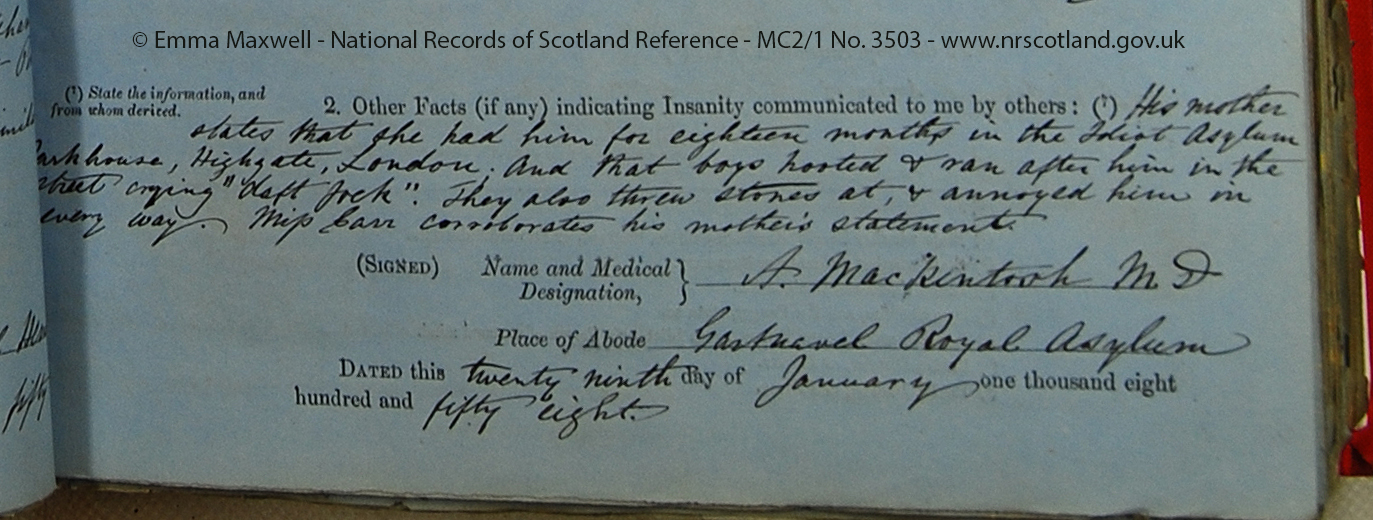
Admission forms for John Rae Thomson MC2_1 No. 3503 image 3 section _ Facts indicated by others_ the boys called him “daft feck”.jpg
John Rae Thomson - Facts Indicated by Others - “His mother states...that the boys hooted & ran after him in the street crying “daft Jock”. (More images available in the press kit)

These historic mental health records give the story behind the facts. A census record may tell you that your great-grandmother was in an asylum, but not why she was there and that’s what we really want to know. This project, lead by Scottish Indexes, is supported by a growing team of volunteers.


Emma Maxwell, genealogist at Scottish Indexes says, “Our mission is to help people not only research their Scottish family tree, but also understand the lives of their ancestors.”
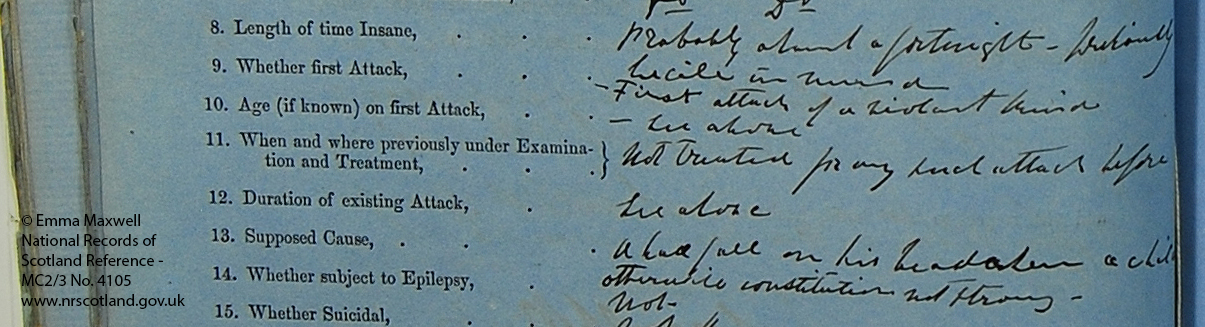
MC2_3 No. 4105 page 2 _ Question 13_ Supposed cause _  A fall on his head as a child.jpg
George Patrick Baillie - Supposed cause -  A fall on his head as a child (More images available in the press kit)


The records being indexed by Scottish Indexes are held by the National Records of Scotland (NRS) in Edinburgh. Without an index they are hugely time-consuming to search and access to the records would usually mean a trip to Edinburgh. These records contain not just names, dates and places but personal information. For example the admission form of John Rae Thomson tells us that the supposed cause of his mental health problems was ‘Premature Birth’. The same record gives his mother’s account of how boys tormented this poor 26 year-old.


Viv from Scotland says, "Although I knew that some of my relatives were in mental health institutions, the indexes at Scottish Indexes and linked original records have allowed me to find out far more about their stories. I feel that I know so much more about these people, and the information is invaluable."


Ailsa from Australia says, “I have been using Scottish Indexes for quite some time now and found many references to my own family within them. They are great for me to use from Australia.”

ENDS

For further information please contact:
Emma Maxwell, Genealogist, Scottish Indexes, info@scottishindexes.com


Notes to the Editor


  • We have prepared a press kit containing 15 images which can be used across all media platforms (download here: www.scottishindexes.com/press_kit.zip). These show full pages of the records and we have selected certain interesting sections of each page which we thought would be of particular interest to your readers. Each is embedded with a copyright statement (approved by the NRS) for your convenience. The examples given can be found in our index: MC7/1 p. 168  - John Rae Thomson and MC7/1 p. 173 - George Patrick Baillie


  • www.scottishindexes.com is run by Scottish genealogists Graham and Emma Maxwell, a husband and wife team based in East Kilbride, Glasgow, Scotland. Indexes are created by Graham and Emma with the help of a team of volunteers. All indexes are free to view and the National Records of Scotland (NRS) reference is given so users can either access the documents without charge at the NRS, or purchase the service from Scottish Indexes.







40,000 Scottish Mental Health Records

We have been working along with a very hard working team of volunteers and we have now reached a milestone in our project to index Scottish mental health records. We have indexed the first 40,000 entries.

If you have not used these records before you will be amazed by them. Sometimes the stories are sad, sometimes reassuring, but there are so many stories to tell. For example here is an excerpt from the entry of Jean McTavish or McAlpine. Jean was aged 60 and a widow, it seems that the ‘supposed cause’ of her health problem was intemperance. Below is an account of what a doctor observed. It seems she imagined herself to be only 26 years of age, and that she was a bird.

Reading these records makes the people come to life in our minds, I can almost picture poor Jean in front of the official, looking rather older than her 60 years perhaps, but all the while believing she was only 26. Granted, this record does not answer all our questions, but it makes Jean real. It tells us more than the basic records and it preserves the memory of poor Jean for her descendants.


Friday, 14 July 2017

For the Love of Genealogy - One Client’s Story

A client came to us recently with a birth certificate form 1855. On the document there is a correction to say that the Sheriff Court had reached a decree and named the father. Our client would like to find more information on this case: who wouldn't?


The problem is that the case was heard in Aberdeen. Unfortunately, the volumes of extracted decrees for Aberdeen Sheriff Court are largely missing (we have indexed the few remaining volumes which are held by the National Records of Scotland). The processes, a type of court document, do survive and they can contain very interesting information, we have even found love letters. The problem is that it can take hours of work to find the entry you need.


The NRS catalogue states about the Aberdeen Processes, “Some processes have been filed under dates other than year of Interlocutor (sometimes through misreading of the figures), but most will be found in the two years before or after that date.”


Our client decided she wanted to search for the 1857 processes. We began our search some months ago. As you can imagine, even in the 1850s, Aberdeen Sheriff Court was busy so there are a lot of boxes (you can see a photo of a box of processes on our website).


There are 10 boxes for 1857, to search 2 years either side (as is suggested in the NRS catalogue) would mean searching 55 boxes!


We have now searched 15 boxes, all the 1857 boxes and some either side. We have found 167 cases… but none of them are the case we are looking for.


The good news is that by making this search we have noted all these other cases so that you can now search these entries on www.scottishindexes.com. We want to say a huge thank you to the client who has helped us add these cases, and let you know that if you had an illegitimate ancestor in Aberdeen it may be worth searching our website to see what you can find. If you do find a case which helps with your research, take a moment to think about our lovely client who can’t find her case.


Monday, 5 June 2017

Genealogy Beyond the Internet

Every week more records are added to the hundreds of genealogy websites. Find My Past release new records every Friday. We add records as we index them and sites like Ancestry add their own records and index records from a large collection of other websites. Never has it been easier to research your family tree online.

The reality is however that what is online is just a drop in the ocean of the records that are available. In fact, the records that are not online are often the more interesting records.

We have indexed a small proportion of Scottish prison records but there is a lot more work to do! The National Records of Scotland hold some fascinating records, such as property records and deeds which can hold the key to unlocking your family history.

Sometimes though, in the records we have available, we have a clue. If we stop and think about the records we have easy access to we can open up a world of further possibilities.

Here’s an example. A client came to us recently because she noticed from the 1871 census that two of her relatives were in the Mossbank Industrial School. This was a tantalising piece of information, why were the boys there? How long where they at the school for? So many questions.

We were able to tell her that the records of the Mossbank Industrial School are held by the Glasgow City Archives at the Mitchell Library. Sadly there is no online catalogue but their website states that they have got records of pupils.

We were commissioned to go and investigate. We found that very detailed records survive for the school. The two lads were admitted in 1870 and are described as ‘Destitute’. We located another volume of records, this time discharge records and these were the most fascinating. On leaving the Industrial School regular information was sent back and recorded in the register. Here are a couple of entries I liked. “Doing Well, is employed in Mills. Stays with Father at Innerleithen. Had a letter on 23rd January 1874.” “Still doing well. Heard from him on the 31 March 1876”.*

I just love these wee piece of information. From the lads being released on licence in November 1873 right through to 1876 we can see that they did well; where else could we find these details?

The next time you are researching think about what the census is telling you, ask questions and try to find the records to answer them. If you need some help just get in touch and we can help. The above research was done for just £25. Hiring professionals doesn’t have to break the bank but could help you break down a brick wall. 

*This information is taken from items D-ED7/146/5/2 and D-ED7/146/3/1 both of which are held by the Glasgow City Archives.